Tag: liquidity

  • Fed’s Barr renews concentration on liquidity, very long-phrase personal debt amidst slate of pending reforms

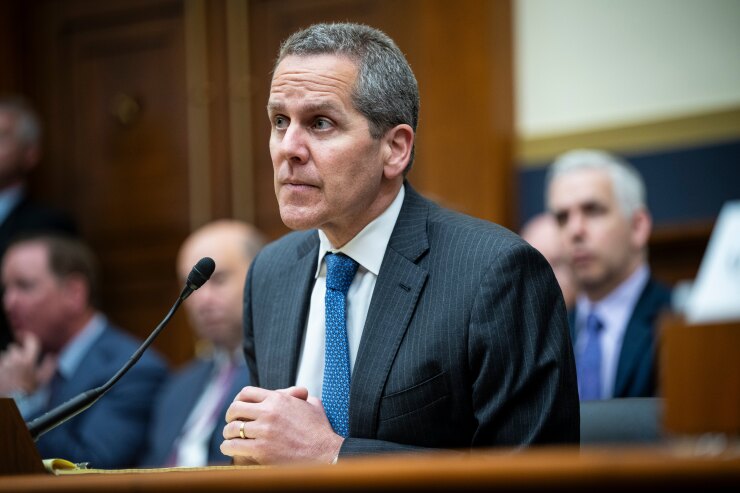
    Michael Barr Federal Reserve vice chair for supervision Michael Barr talked about in a speech Monday that “it’s very vital that uninsured depositors have self worth that their money will probably be generally obtainable,” however reported tiny in regards to the proposed money hikes outlined in earlier 12 months’s Basel III endgame proposal.

    Bloomberg News

    WASHINGTON — The Federal Reserve’s Vice Chair for Supervision Michael Barr Monday claimed that regulators are focused on enhancing banks’ liquidity and lengthy-term bank card debt stipulations in purchase to make them extra resilient, however defined tiny regarding the Basel III endgame proposal’s stipulations that might hike main banks’ cash specs.

    Speaking on the Federal Reserve Bank of Atlanta’s twenty eighth Yearly Economic Markets Conference, Barr highlighted these three targeted adjustments to the liquidity framework as properly as different actions underway on the Fed to ensure a robust banking supervision framework.

    In purchase to bolster banks’ liquidity positions, he suggests the Fed is bearing in mind necessitating massive banking firms to handle a naked minimal quantity of rapidly provided liquidity based mostly on their reliance on uninsured deposits.

    “Uninsured deposits usually characterize arduous money needed to satisfy in shut proximity to-time interval needs — like paying out bills or making payroll — and we’ve got seen depositors act promptly to withdraw these assets if their availability is unsure,” he stated. “It is important that uninsured depositors have self worth that their cash will probably be generally on the market, if required, and this self-worth can be elevated by a prerequisite that massive monetary establishments have readily provided liquidity to satisfy requests for these deposits.” 

    Barr additionally further that as part of this measure, the Fed is pondering of incorporating some obligatory discounted window utilization.

    “Incorporating the worth reduce window right into a readiness want would additionally reemphasize that supervisors and examiners view use of the lower cost window as acceptable and unexceptional,” he claimed. “We are in search of recommendations from banks, and this opinions will help us to even additional prioritize operational enhancements.”

    Drawing on courses from lender failures in March 2023, the regulator additionally floated the plan of limiting banks’ reliance on held-to-maturity belongings as half of their liquidity buffers — just like the liquidity protection ratio and the interior liquidity fear check out stipulations. He says this might improve steadiness within the course of rigidity illnesses. Held-to-maturity property are usually not very simply convertible to cash with out having vital losses. These sorts of a firesale prompted depositor unease that in the long run led to the unraveling of SVB and Signature monetary establishment remaining 12 months.

    Barr additionally suggested recalibrating deposit outflow assumptions for large-net-really value individuals and firms affiliated with enterprise cash or crypto-asset-associated companies to take care of their speedy withdrawal habits observed within the course of present present market nervousness. 

    “As we noticed within the course of the strain of a 12 months again, these kinds of deposits can flee banking establishments considerably further rapidly than earlier anticipated,” Barr talked about.

    Barr stated little in regards to the Basel III endgame proposal’s funds hikes for an important banks, which the Federal Deposit Coverage Corp. estimated at 16% however another analysts have estimated as even larger. Alternatively, Barr touted the proposal’s requirement that midsized monetary establishments additionally consist of unrealized losses as part of their money adequacy assessments, something solely the biggest monetary establishments are presently wanted to do. 

    “With respect to the acute issues we observed earlier yr, the proposal would additionally lengthen the requirement to copy the results of unrealized losses on cash to all substantial banks,” Barr defined. “This would higher replicate curiosity payment chance in funds, a challenge that carried out an enormous function in each of these SVB’s and 1st Republic’s failures.”

    Barr went on to emphasise the worth of loss-absorbing property for monetary establishments in light of earlier 12 months’s banking failures. He claims prolonged-term debt — which regulators can use to recapitalize a bridge financial institution within the wake of a failure — can lower the probability of a monetary establishment function and improve the percentages for orderly decision by producing a failed financial institution way more enticing to possible customers. 

    Final August, monetary establishment regulatory companies sought basic public responses on a proposal requiring vital banking firms to carry a minimal quantity of extensive-expression bank card debt to soak up losses in circumstance of failure. According to Barr, quite a few feedback supported the proposal’s intent, although some introduced methods that the Fed is now completely analyzing.

    The Basel III endgame proposal has been remarkably controversial and deeply opposed by the banking discipline because it was preliminary issued very final July. Fed chair Jerome Powell claimed in March that “broad and supplies” changes can be designed to the remaining Basel proposal, nonetheless irrespective of whether or not the rule is finalized with changes or re-proposed stays unclear.

    With conversations nevertheless ongoing amongst members of the Federal Reserve Board and amongst federal companies, Barr stated all policymakers involved want to not solely reinforce the completed Basel rule however the cumulative protection framework all-around monetary establishment security and soundness. 

    “We are attentive to the interactions throughout these proposals as very effectively because the possible load,” claimed Barr. “Guaranteeing that every particular person of these three components is appropriately calibrated will help to guarantee that banking establishments proceed to be highly effective and able to protect their essential place furnishing credit score rating to U.S. households and firm under a broad vary of issues.”

  • Why private capital should really be permitted to give liquidity to Ginnie Mae servicers

    Servicers of Ginnie Mae mortgages have been beneath the regulatory microscope, with worries about their liquidity attracting sizeable consciousness, along with from the Money Stability Oversight Council. But the dialogue overlooks how the federal governing administration alone immediately contributes to this liquidity hazard. One easy decision is for the authorities to take away the boundaries it has developed, to let private cash to present the important liquidity.

    Servicers take part in a pivotal function within the intricate web site of home mortgage financing, significantly exterior of mere cost assortment. For mortgages pooled in Ginnie Mae or GSE home loan-backed securities, servicers want to advance missed mortgage mortgage funds to MBS holders and pay again taxing authorities and hazard insurers if escrow assets are quick. If a borrower doesn’t make these funds, servicers should keep sufficient liquidity ({dollars}) to make these funds. These sorts of servicing developments are lastly reimbursed by the GSEs or by the authorities private mortgage guarantor, this kind of because the Federal Housing Administration, the Section of Veterans Affairs or the Division of Agriculture.

    Periods of monetary pressure, which may result in earnings disruption and disproportionately have an effect on debtors beneath the govt. programs financed by Ginnie Mae, can induce liquidity pressure for Ginnie Mae servicers at notably the time debtors are most reliant on these companies for assist to help maintain them of their homes. Additionally, the mix of upper delinquency expenses, lengthier time frames for servicers to progress cash, and slower and rather a lot much less predictable reimbursement of servicing advances signify that Ginnie Mae MBS pose greater liquidity hazard for servicers than individuals in GSE MBS.

    These necessary dissimilarities amongst Ginnie Mae and GSE servicing have been exacerbated as basic public plan interventions have prolonged delinquency decision time frames, in swap rising the need want for servicer improvements. Although these changes are supposed to acquire debtors, the influence is that the liquidity desired to make servicing improvements on behalf of delinquent debtors is best now than in earlier a very long time.

    Extensive-phrase choices to reducing down servicer liquidity chance require consideration of how the governing administration functions take care of mortgage mortgage delinquency. These days, debtors are introduced a number of extra months (or yrs) to handle their delinquency than previously. Lengthy-expression reforms may put FHA, VA and USDA on par with the everyday private mortgage market and reduce the extent to which home mortgage servicers ought to finance these appreciable borrower restoration (or failure) timelines.

    But, this type of structural reforms to the federal authorities loss mitigation functions would contain a long-time interval exertion and the sector requires fast strategies to deal with the money stream mismatch that has set significantly elevated liquidity pressures on some servicers. Facilitating bigger private financing is a extra profitable route to strengthening market liquidity. Especially, Ginnie Mae proper now can replace its recommendation and complement its contracts in a method that might make it rather a lot simpler for private capital to carry out a bigger goal in financing servicing operations.

    Impartial property finance mortgage monetary establishments, or IMBs, that service Ginnie Mae monetary loans encounter certainly one of a form liquidity issues, nonetheless endeavours to safe personal sector funding are stymied given that of the style through which Ginnie Mae asserts its possession curiosity in servicing progress reimbursements within the perform a servicer fails. This signifies that FHA, VA and USDA reimbursements that might ordinarily repay the non-public mortgage servicer for the developments would in its place be compensated to and retained by Ginnie Mae. As a remaining outcome, banking firms and different potential sources of personal cash prohibit or keep away from what they take a look at unsecured lending to IMBs for servicing enhancements, and servicers should uncover different strategies to finance these improvements. In specified present market environments that is difficult and will induce servicer failures. The irony, in fact, is that these improvements merely intermediate amongst two federal obligations — the Ginnie assure to traders and the FHA, VA and USDA assurance to the mortgage supplier.

    Commercial monetary establishments and different assets of non-public capital would additional willingly lend from authorities servicing developments that the federal government has promised to repay if that they had some assurance that Ginnie Mae would perceive their curiosity within the celebration Ginnie Mae turned the proprietor of the servicing rights following a servicer failure. But Ginnie Mae has traditionally been unwilling to do that.

    Ginnie Mae’s resistance stems from the statutory textual content that servicing belongings obtained via default are the “absolute dwelling” of Ginnie Mae, topic solely to the rights of the security holders — because of this Ginnie’s reluctance to agree that pursuits of advance financiers ought to be acknowledged and shielded. But Ginnie Mae’s essential goal — guaranteeing that safety holders will get the funds due them — is pertinent on this article. For funds that had been appropriately extremely developed to the security holder, there isn’t a basic public intent served by Ginnie Mae impounding the reimbursements of those improvements (within the state of affairs of the servicer’s failure) and forcing servicing liquidity suppliers to get losses.

    This interpretation of the “full property” clause has extreme outcomes: It shuts out banking establishments or different people from an ever extra essential financing performance that they’re completely suited to provide (and do in different segments of the market) and pushes servicers into bigger price ticket funding prospects. Ginnie Mae’s full residence authorized rights can be preserved though additionally offering personal funders the assurances they are going to want to provide progress funding of authorities-backed monetary loans.

    There is not any statutory or regulatory textual content that explicitly prohibits Ginnie Mae from growing an association for progress funding that might safe the pursuits of liquidity firms if a Ginnie Mae issuer defaults. Ginnie Mae has the lawful authority and discretion to replace its steering to completely acknowledge and shield Ginnie Mae’s full authorized rights to the servicing obtained via default when formally memorializing that advance reimbursements Ginnie Mae will get from authorities insurance coverage coverage guarantees, borrower cures or financial institution mortgage payoffs will be handed on account of to the advance financier. Ginnie Mae’s absolute rights, and the company’s means to go for to cross on account of advance reimbursements, will not be in battle. Very the reverse — strengthening private funding of Ginnie monetary loans improves the advantage of the Ginnie servicing asset — a apparent acquire to Ginnie Mae and to debtors.

    Formally creating this association would profit Ginnie Mae. Boosting personal cash financing of servicer developments straight helps a essential servicing perform. In its absence, servicers have arrive to depend on borrowing towards the worth of the servicing authorized rights, a extra dangerous asset for liquidity suppliers that results in even worse funding phrases for the servicer. Ginnie Mae by itself, introduced the shortage of a private market place alternative, has had to give “previous resort” funding through its PTAP utility, which in the end depends on taxpayer assist.

    Facilitating property finance mortgage liquidity with personal money is an individual of Ginnie Mae’s chartered wants, and nobody added advantages from monetary establishments and personal liquidity distributors sitting down on the sidelines. As dwelling finance mortgage originators and servicers put into follow the extra stringent firm economical necessities of newest a very long time, policymakers really should flip their consideration to added methods to enhance the resilience of the housing finance method. Acquiring methods for private cash to interact in a much bigger function, and re-examining structural deficiencies within the govt applications, are excellent locations to begin out.