Tag: keep

  • Loan providers keep fees steady irrespective of inflation spike

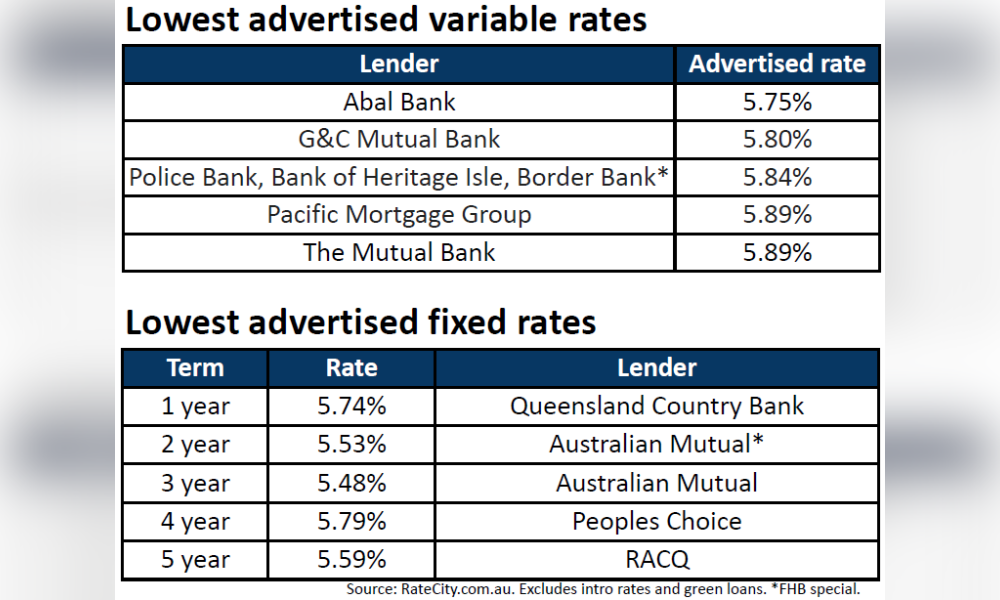
    The lowest marketed preset costs from different mortgage corporations are 5.74% for a simply one-year time period (Queensland Nation Lender), 5.53% for a two-12 months time period (Australian Mutual), 5.48% for a a few-year expression (Australian Mutual), 5.79% for a four-12 months expression (People’s Choice), and 5.59% for a 5-12 months phrase (RACQ).

    In the variable quantity group, the prime decisions embrace issues like Abal Lender at 5.75%, G&C Mutual Lender at 5.80%, Law enforcement Lender, Financial establishment of Heritage Isle, and Border Lender at 5.84%, Pacific Home finance mortgage Team at 5.89%, and The Mutual Lender at 5.89%.

    “The most cost-effective a person-yr mounted degree is at present 5.74%, when probably the most reasonably priced variable is 5.75%, excluding introductory price loans,” Tindall claimed. “This all of a sudden helps make for an attention-grabbing equation for debtors looking out to protect them selves versus the likelihood of rather more price hikes.

    “However, the inflexibility of a preset cost, and the additional admin that it brings is nonetheless virtually actually sufficient to dissuade most debtors at this stage.”

  • Home finance loan pressures mount as charges keep

    Mortgage pressures mount as premiums keep | Australian Broker News

    News

    Home finance loan pressures mount as costs maintain

    Property finance loan arrears on the rise

    Mortgage pressures mount as rates hold

    The Reserve Bank has managed a 4.35% arduous money cost amid superior inflation, with CoreLogic noting rising residence finance loan arrears and Finsure suggesting possible charge hikes.

    “For some extra time-expression context, the latest funds stage location is 1.8 share components better than the pre-COVID ten years typical of two.56%,” mentioned Tim Lawless (pictured beforehand talked about nonetheless left), research director at CoreLogic Asia Pacific.

    Economic and stage outlook

    In spite of ongoing excessive inflation, particularly within the suppliers sector, and the chance for inflationary pressures from the newest value vary actions, the consensus between economists and cash markets implies that the long run RBA go may very well be a cost lower, presumably by March following yr.

    “The consensus between economists is that fee hikes are accomplished and the next transfer from the RBA can be a slash, however the timing could be very uncertain,” Lawless reported.

    Home finance loan business dynamics

    When the funds value has surged, variable residence finance loan prices haven’t risen to the an identical extent, due to sturdy competitors among the many loan firms.

    The common variable residence loan stage for brand new operator-occupier loans is now throughout 6.27%, with charges for investor monetary loans a bit higher at 6.53%.

    “No doubt debtors are searching throughout for the best costs,” Lawless defined.

    Inspite of the safety in housing costs and an increase in home income, mortgage arrears are trending upward. In accordance to APRA data for the March quarter, 1.6% of family loans at the moment are in arrears, up from 1% within the prior quarter.

    “With curiosity charges established to keep at their latest ranges proper up till at minimal late this calendar yr, alongside a gradual loosening in labour present market circumstances and lessened preserving buffers for many debtors, it’s most certainly mortgage loan arrears will improve additional extra,” Lawless reported.

    Different views on funds value actions

    While RBA has opted to keep charges, Simon Bednar, CEO of Finsure Team, advisable that features like cussed inflation and a strengthening work market place might immediate the RBA to lift premiums once more.

    “We nonetheless have cussed inflation to take care of, coupled with a strengthening activity market place and approaching federal authorities stimulus which incorporates tax cuts.” claimed Bednar (pictured earlier talked about right). “For that rationale, I really feel the RBA could be justified in lifting the money value, after which maintain steady for the remainder of the 12 months.”

    Get the preferred and freshest residence loan information shipped appropriate into your inbox. Subscribe now to our FREE daily publication.

    Related Stories

    Maintain up with probably the most present data and events

    Be part of our mailing checklist, it’s completely free!

  • Mortgage rates keep sliding after inflation report

    Mortgage rates continued transferring decrease this week, because the 10-year Treasury yield they’re partially priced off of, additionally continued their principally downward slide.

    The Freddie Mac Primary Mortgage Market Survey discovered the 30-year mounted fee mortgage at 7.02%, on May 16, down 7 foundation factors from seven days prior. But rates are nonetheless increased than they have been one 12 months in the past, when the 30-year FRM averaged 6.39%.

    The 15-year FRM had a bigger week-to-week decline, at 10 foundation factors to six.28%. For the identical week in 2023, it was at 5.75%.

    “Given the information that inflation eased barely, the 10-year Treasury yield dipped, resulting in decrease mortgage rates,” Sam Khater, Freddie Mac chief economist, mentioned in a press launch. “The lower in rates, albeit small, could present a bit extra wiggle room within the budgets of potential homebuyers.”

    The Consumer Price Index discovered inflation was up on a month-to-month foundation at 0.3%, however this was decrease than the prior interval’s 0.4% and a lesser improve than some anticipated.

    The 10-year yield was at 4.37%, down from a detailed of 4.45% on May 9, though it did return as much as 4.53% on May 13.. 

    Lender Price information posted on the National Mortgage News web site as of 11:45 a.m. had the 30-year FRM at 6.856%, in contrast with 7.115% one week prior.

    The 30-year FRM as posted on Zillow’s web site as of late morning Thursday was at 6.55%, down 24 foundation factors from the prior week’s common of 6.79%.

    Recently launched information on inflation and retail gross sales present customers are slowing down their actions, mentioned Orphe Divounguy, senior macroeconomist at Zillow Home Loans.

    “Adding to experiences of easing wage progress and dwindling shopper financial savings final week, this week’s inflation report confirmed that shopper value progress is moderating,” Divounguy mentioned in a Wednesday night assertion. “Lower than anticipated retail gross sales information additionally pointed to a slowing economic system.”

    That is pushing mortgage rates to their lowest stage since late February.

    The spring residence shopping for season has began on an excellent observe, mentioned Amy Lessinger, Remax president, in its April National Housing Report.

    “Gains in residence gross sales, new listings and the variety of properties on the market are all indicators of a extra energetic, rebalancing market,” mentioned Lessinger. “This has occurred with out a important drop in curiosity rates — suggesting that consumers and sellers could also be much less apt to delay their plans this 12 months.”

    But Redfin, which places out a rolling four-week report on Thursdays, famous that whereas new listings have been up 10% from a 12 months in the past, they have been flat with the prior week.

    The excellent news was that mortgage rates, as tracked by Redfin, have been beneath 7% for the primary time in 5 weeks.

    “Sellers know that prime mortgage rates imply they need to anticipate negotiations, anticipate gives to come back in beneath record value, and be prepared for some forwards and backwards on issues like repairs and shutting prices,” mentioned Marsha McMahon-Jones, a Redfin agent from Palm Springs, California, in a press launch. “Buyers could not be capable to get a decrease mortgage fee, however they’re typically getting properties for barely lower than the asking value.”

    As for the housing market and rates going ahead, “Financial markets nonetheless anticipate at the very least one or two central financial institution fee cuts this 12 months,” Divounguy mentioned. “Expect extra fee volatility forward because the Fed and traders look forward to extra conclusive proof of a return to low, secure and extra predictable inflation.”

    A veteran mortgage originator can also be not fairly able to have fun due to the CPI information.

    “The markets are rallying and cheering as a result of that is the following step towards the launch of a fee reduce by the Fed,” Melissa Cohn, regional vp of William Raveis Mortgage, mentioned in a press release. “It’s not sufficient to get the Fed to chop rates.”

    More information factors want to come back out, “and there must be extra consistency on an ongoing foundation earlier than we’ll really see the Fed reduce rates,” she continued.

    However, Louis Navellier, an funding banker, predicted two fee cuts by the Federal Open Market Committee, with the primary coming on the July 31 assembly, and the second most likely in September.

  • Expect a foreclosures spike in the coming months Pandemic backlog of critically distressed mortgages envisioned to fuel the elevate, even though bump-up will keep on being below historic typical

    Fed holds premiums common for the sixth straight time

    By Didier Malagies

    02 May properly, 2024

    The Federal Reserve ’s Federal Open up Marketplaces Committee (FOMC) preserved its short-term coverage fascination charge fixed at a array of 5.25% to 5.5% for a sixth consecutive meeting on Wednesday. “The Committee doesn’t count on it will be correct to reduce the purpose choice till finally it has acquired elevated self-worth that inflation is relocating sustainably in the direction of 2%,“ the FOMC acknowledged in a assertion. “In addition, the Committee will keep on reducing its holdings of Treasury securities and company debt and firm mortgage‑backed securities.“ In the course of their previous assembly in March , policymakers indicated that they proceed to envisioned 3 fascination degree cuts in 2024. But with inflation remaining sticky and unemployment being down below 4%, these expectations are getting significantly much less very probably. Modern financial data has not specified the Fed self-confidence that inflation will proceed to decline. Solid inflation data in the first quarter, coupled with a sturdy labor market , have postponed expectations for the to begin with Fed cost decrease. In April, Fed Chairman Jerome Powell, talking at the Washington Forum , manufactured it clear that quantity cuts weren’t imminent thanks to the vitality of the financial system. The total financial system has managed shocking momentum in spite of the present diploma of shorter-phrase charges. With the unemployment price down below 4%, suppliers are steadily incorporating workers and precise wage progress is observable as inflation eases. Despite the undeniable fact that upward actions in inflation are noteworthy, important growth in the direction of the Fed’s 2% purpose has been constructed. “It’s not going that the subsequent protection worth go will be a hike,” Powell instructed journalists on Wednesday in the course of the FOMC’s press assembly. “In order to hike the charges, we’d will want to see persuasive proof that our coverage stance just isn’t sufficiently restrictive to convey inflation sustainably down to 2% greater than time. Which just isn’t what we’re viewing at the second.” While Powell emphasised the unlikelihood of future price hikes, he additionally remained imprecise about the Fed’s upcoming rate of interest trajectory. “We didn’t see growth in the very first quarter. It seems that it will purchase lengthier for us to entry that place of self worth,” Powell defined. “I actually have no idea how extended it will simply take. … My personal forecast is that we will get began to see growth on inflation this calendar 12 months. I by no means know that it will be sufficient to decrease premiums we will have to allow the particulars lead us on that.” In a new progress, the Fed introduced an easing of its quantitative tightening protection. Starting up in June, the amount-placing total physique will decreased the roll-off price of its Treasury securities from $60 billion to $25 billion per thirty day interval. This means that even though the Fed will not start promoting Treasurys in June, it will make it doable for fewer of them to mature. It will not change its roll-off worth for residence finance loan-backed securities (MBS), which will stay at $35 billion for each month, in accordance to Xander Snyder, senior enterprise critical property economist at 1st American. “The FOMC didn’t change the ongoing passive roll-off of its MBS holdings however did word that any prepayments outdoors of the persevering with $35 billion cap could be reinvested in Treasuries,” Mike Fratantoni, senior vice chairman and essential economist for the Home finance mortgage Bankers Affiliation, mentioned in a assertion. “We depend on residence mortgage premiums to drop later on this 12 months, however not as a lot or as fast as we previously had predicted.” In addition, Powell reiterated the Fed’s willpower to carrying forward the Basel III endgame restrictions in a manner that’s reliable to Basel and likewise related to what the jurisdictions in different nations are conducting. Since the March FOMC meeting, Freddie Mac’s regular 30-year fixed home mortgage worth has better from 6.74% to 7.17%. Right earlier than the up coming FOMC assembly on June 12, two supplemental inflation readings are predicted. “While it’s a chance, I actually don’t contemplate that we’ll see a lot enhance in residence finance mortgage premiums following this Fed convention, for the cause that the Fed has been keen to enable the info direct at this part in the cycle,” Real property agent.com chief economist Danielle Hale reported in a assertion. “In get to see mortgage costs drop additional drastically, the Fed will want to see much more proof that inflation is slowing.”  For homebuyers and sellers, this suggests that housing affordability will keep a prime thought, maybe driving dwelling purchases in reasonably priced markets, predominantly in the Midwest and South, in accordance to Hale.

  • Why little one boomers keep on being competitive in the U.S. housing industry

    In addition to inflation and scholar financial institution mortgage balances suppressing the homebuying possible of the millennial know-how, child boomers’ fortunes — particularly as the pandemic ballooned their residence values — are remaining the variation in the U.S. housing market. This is in accordance to Ali Wolf, most important housing economist at Zonda, in
    a brand new column launched by Fortune

    A key differentiator in the degree of competitors for residences — which is produced by millennials attaining homebuying potential as extra boomers begin off downsizing, placing them at odds in extra of in the identical way-sized houses — is that boomers can telephone on the fairness they’ve designed up.

    “In right this moment’s housing industry, there’s a main overlap in between choose new child boomers and choose millennials,” Wolf knowledgeable Fortune.

    As “empty-nester” toddler boomers are searching for a retirement setting, millennials are sometimes looking for the very same forms of properties as their starter home, she claimed.

    “The key distinction in this text is that the little one boomer will in all probability be in a place to faucet family equity by promoting their present residence, making it doable for them to more than likely make a extra compelling give you on the dwelling versus the millennials, specifically if the latter group are nonetheless leasing,” she mentioned.

    Whilst most new child boomers are wanting to stay in the precise relative place they reside in now, data from the Nationwide Affiliation of Realtors (NAR) implies that toddler boomers simply take main locations amongst the each homebuyers and sellers at the second. Childcare fees are additionally an monetary depressant for millennial mother and pop, but additionally direct their baby boomer moms and dads to check out and uncover a property that may allow them to to assist by wanting following their grandchildren.

    A unique half that’s maybe at interact in in this dynamic for the reverse mortgage market might be the Dwelling Fairness Conversion Home finance mortgage (HECM) for Purchase (H4P) program on account of the truth rather more new child boomers are wanting at receiving concerned in homebuying.

    Traditionally
    underutilized in comparability with common HECM monetary loans, H4P loans have ordinarily been a extra sturdy provide. Merchandise proponents vigorous in the H4P present market, nonetheless, say that there’s renewed choice in it provided seniors’ massive equity phases.

    According to the latest model of the Reverse Home finance mortgage Marketplace Index (RMMI) measured by the National Reverse Mortgage mortgage Creditors Association and RiskSpan, senior-held home equity sits at $12.39 trillion. It did
    current a current fall, however about the previous twelve yrs the senior cohort has discovered a roughly $9 trillion purchase in their equity concentrations.

    For reverse mortgage mortgage gurus with genuine property brokers as referral companions, some are viewing previously good encounters direct to new group in the H4P enviornment, specifically amongst younger brokers in accordance with 1 market skilled.


    “[Agents] are likely to go together with what they know,” claimed Jeff Foody of Northwest Reverse House mortgage in an
    interview with RMD in April. “And the plan of latest financing tends to be a younger agent’s sport, I suppose. People brokers who simply took a course and get enthusiastic, or the prolonged-expression referral associates ship this enterprise no matter the present market issues. But then additionally in these sector issues, it tends to be the newer brokers which are listening to about [H4P] for the 1st time [who] are rather more open to it.”

  • Non-QM delinquencies improve, but losses keep on being subdued

    The delinquency prices for securitized non-skilled residence loans are on the rise as these loans keep on to interval but they proceed to be in simply an applicable vary, in accordance to Morningstar DBRS.

    Meanwhile, new issuances had their highest quarter because of the truth the 2nd quarter of 2022 as most important-to-secondary business spreads tightened even however home mortgage expenses improved.

    As of March 25, the delinquency cost for non-QM MBS was 5.09%, up from 4.88% 1 month prior to now, 4.81% on the conclude of earlier calendar yr and three.75% for the very first quarter of 2023.

    “Non-QM RMBS constructions throughout the sector held moderately protected as practically all excellent transactions continued to go their deal efficiency assessments,” acknowledged the report, whose lead creator was Mark Fontanilla, senior vice chairman. “Meanwhile, collateral losses on the deal stage remained modest, which assisted make enhancements to credit score enhancements, albeit at a slower tempo than when speeds had been significantly larger in 2022.”

    This compares with an entire RMBS delinquency fee of 1.52%, a slight drop from the prior month’s 1.55% but up from 1.47% from the conclude of 2023 and 1.42% above the previous 12 months.

    Prime credit score RMBS had an 89 foundation level delinquency charge in March, up by 6 foundation particulars from February, 7 basis components versus December and 4 foundation components from March 2023.

    In the meantime, on a thirty day period-to-thirty day interval basis, the late cost degree for authorities-sponsored enterprise credit score rating danger switch reductions was 4 basis factors diminished at 1.49% and property finance mortgage insurance coverage plan-joined notes was 5 foundation factors decrease at 1.24%.

    “Gathered web losses throughout non-QM swimming swimming pools, that are however subdued as a restricted housing business and resilient financial backdrop proceed to help residence mortgage credit score historical past normal efficiency normal,” the report identified.

    An unemployment charge of beneath 3.8% was down under historic norms. Inflation, although even now hotter than the Federal Reserve likes, held at in between 3.8% and three.9%.

    The 30-calendar yr mounted worth residence mortgage remained within the 6.6% to six.9% fluctuate for more often than not interval, which allowed people to get employed to that pure setting, the report claimed.

    Prepayment speeds have gotten a bit quicker on non-QM affords, but are even now gradual relative to previous train.

    For the March time frame, the 1-month steady prepayment fee was 8.9%, when put next with 7% from the December statements.

    “Prepayment speeds within the different key RMBS segments had been presumably slower or solely marginally speedier versus non-QM in [the first quarter],” the report acknowledged. “For comparability, benchmark GSE CRT reference swimming pools and key credit standing collateral swimming pools together however remained within the location of three% to 4% CPR, while non-QM in combination completed Q1 at virtually 9% CPR.”

    When it arrives to new securitizations, pricing amount of $8.8 billion for the preliminary quarter was up 30% from the earlier three months. It was additionally essentially the most prolific quarter for the reason that $9.6 billion developed within the second quarter of 2022, Morningstar DBRS acknowledged, citing Finsight.com data.

    “In spite of Treasury charges edging up contemplating the truth that December, non-QM RMBS spreads ended up on a fundamental tightening sample, serving to keep provide execution expenses much less unstable and much more contained than in This fall 2023,” the report stated.

  • Existing-home revenue decline as charges keep consumers sidelined

    Product gross sales of formerly-owned residences within the U.S. fell in March from a a single-12 months larger, underscoring the lingering results of superior residence mortgage premiums and elevated value ranges. 

    Agreement closings diminished 4.3% from a thirty day interval earlier to a 4.19 million annualized quantity, in accordance to Countrywide Association of Realtors info unveiled Thursday. The pace was according to the median estimate of economists surveyed by Bloomberg.

    “Though rebounding from cyclical lows, dwelling earnings are caught primarily as a result of want prices haven’t made any huge strikes,” NAR Main Economist Lawrence Yun reported in an announcement.

    Homes in a row Residences in Hercules, California, US, on Wednesday, Aug. 16, 2023. The US 30-12 months residence mortgage quantity rose to 7.16% final 7 days, matching the optimum contemplating the truth that 2001 and crimping equally gross sales and refinancing exercise.

    David Paul Morris/Bloomberg

    , hindering new momentum within the housing sector. Buys of recent homes have additionally cooled as future consumers transfer to the sidelines proper up till financing expenditures ease. 

    Other housing details this week confirmed builder optimism leveled off and improvement commences lessened. Mortgage mortgage charges keep on being rather more than 2 instances as superior as on the end of 2021, and Federal Reserve Chair Jerome Powell on Tuesday defined the Fed is organized to carry charges larger for longer than beforehand predicted in buy to reduce inflation. 

    The stock of beforehand-owned households on the market enhanced 14.4% in March from the same month final calendar yr to 1.11 million. Although stock is even now traditionally very low, it truly is been creeping up as some householders actually really feel they’re unable to carry off relocating any lengthier. 

    At the present product sales fee, advertising and marketing all the homes on {the marketplace} would simply take 3.2 months, in contrast with a 2.7-thirty day interval provide in March of earlier 12 months. Realtors see absolutely anything beneath 5 months of provide as indicative of a restricted market.

    Sales Cost

    The median providing value elevated 4.8% from a yr in the past to $393,500, the most effective for any March on file.

    “Far extra stock is usually welcomed within the newest pure atmosphere,” Yun claimed. “It generally is a glorious time to document with ongoing a number of presents on mid-priced properties and, over-all, home charges persevering with to extend.”

    Some 60% of the properties offered have been in the marketplace place for fewer than a month, and 29% marketed above the document worth, Yun claimed on a name with reporters.

    The NAR’s report additionally confirmed homes remained on the sector for 33 instances on typical in March, down from 38 a month beforehand. 

    Existing-dwelling product sales account for the the better a part of U.S. housing and are calculated when a deal closes.