Tag: inventory

  • Why home prices are still rising even as inventory recovers

    Housing prices rise despite more supply: Here's why

    Anyone out looking for a home in the present day is aware of there’s still valuable little on the market.

    The housing market is simply starting to come back out of its leanest few years in historical past. Inventory of each new and current houses is lastly rising, however there’s something instantly unusual within the numbers: The provide of newly constructed houses seems to be manner too excessive.

    The numbers, nonetheless, are deceiving as a result of unprecedented dynamics of in the present day’s housing market, which will be traced again 20 years to a different unprecedented time in housing, the subprime mortgage growth.

    All of it’s exactly why home prices, which normally cool off when provide is excessive, simply proceed to rise.

    The provide situation

    There is at the moment a 4.4-month provide of each new and current houses on the market, based on the National Association of Home Builders, or NAHB. Months’ provide is a typical calculation used out there to measure how lengthy it will take to promote all of the houses accessible on the present gross sales tempo. A six-month provide is taken into account a balanced market between a purchaser and a vendor.

    Supply was already low initially of this decade, however pandemic-driven demand pushed it to a document low by the beginning of 2021 at simply two-months’ provide. That scarcity of houses on the market, mixed with robust demand, pushed home prices up greater than 40% from pre-pandemic ranges.

    Now provide is lastly starting to climb again, however the good points are principally within the new home market, not on the present facet. In reality, there’s now a nine-month provide of newly constructed houses on the market, almost 3 times that of current houses. New and outdated home months’ provide normally monitor fairly carefully. New development now makes up 30% of whole inventory, about twice its historic share, based on the NAHB.

    Single-family houses in a residential neighborhood in San Marcos, Texas.

    Jordan Vonderhaar | Bloomberg | Getty Images

    “June 2022 recorded the biggest ever lead of latest home months’ provide (9.9) over current single-family home months’ provide (2.9),” wrote Robert Dietz, chief economist for the NAHB. “This separation makes it clear that an analysis of present market inventory can’t merely look at both the present or the brand new home inventory in isolation.”

    This uncommon dynamic has been pushed by each current swings in mortgage charges and an unprecedented catastrophe within the housing market that started 20 years in the past.

    The basis of in the present day’s tough numbers

    This housing market is in contrast to every other due to financial forces in contrast to every other. First, in 2005, there was a large runup in home gross sales, homebuilding and home prices fueled by a surge in subprime mortgage lending and a frenzy of buying and selling in new monetary merchandise backed by these mortgages.

    That all got here crashing down shortly, leading to one of many worst foreclosures crises because the Great Depression and inflicting the following Great Recession. Single-family housing begins plummeted from a excessive of 1.7 million models in 2005 to simply 430,000 in 2011. By 2012, new houses made up simply 6% of the overall for-sale provide and, even by 2020, housing begins had but to recuperate to their historic common of about 1.1 million models. They sat at 990,000.

    Then got here the Covid-19 pandemic and through that point, shopper demand surged and mortgage charges set greater than a dozen document lows, so builders responded. Housing begins shot as much as 1.1 million in 2021. The Federal Reserve was bailing out the economic system, making homebuying less expensive, and the brand new work-from-home tradition had Americans shifting like by no means earlier than. Suddenly, provide was sucked right into a twister of demand.

    Mortgage charge mayhem

    The present unusual divide in provide between newly constructed and current houses can be as a result of roller-coaster mortgage charges, dropping to historic lows initially of the pandemic after which spiking to 20-year highs simply two years later. Millions of debtors refinanced on the lows and now don’t have any need to maneuver as a result of they must commerce a 3% or 4% charge on their loans to the present charge, which is round 7%. This lock-in impact precipitated new listings to dry up.

    It additionally put builders within the driver’s seat. Homebuilders had already ramped up manufacturing within the first years of the pandemic, with single-family houses surging to greater than 1.1 million in 2021, based on the U.S. census, earlier than dropping again once more when mortgage charges shot up. Builders have been in a position to purchase down mortgage charges to maintain gross sales increased, however as of this May, they are constructing at an annualized tempo of 992,000.

    Resale listings improved barely this spring, as mortgage charges fell again barely, and by June, lively listings had been 16.5% increased than they had been the yr earlier than, based on Redfin. Some of that elevated provide, nonetheless, was as a result of listings sitting in the marketplace longer.

    “The share of houses sitting in the marketplace for at the very least one month has been growing yr over yr since March, when progress in new listings accelerated, however demand from patrons remained tepid, as it has been since mortgage charges began rising in 2022,” based on a Redfin report.

    A home accessible on the market is proven in Austin, Texas, on May 22, 2024.

    Brandon Bell | Getty Images

    Growth on the low finish

    On the resale market, the availability is lowest within the $100,000 to $500,000 value tier, based on the National Association of Realtors. That is the place the majority of in the present day’s patrons are. Higher mortgage charges have them searching for cheaper houses.

    Interestingly, nonetheless, whereas provide is growing throughout all value tiers, it’s growing most in that very same lower-end value tier, that means it’s merely not sufficient. As quick as the houses are coming in the marketplace, they are going underneath contract.

    For instance, there’s only a 2.7-month provide of houses on the market between $100,000 and $250,000, however provide is up 19% from a yr in the past. Meanwhile, there’s a 4.2-month provide of houses priced upward of $1 million, however provide is up simply 5% from a yr in the past.

    This explains why home prices stay stubbornly excessive, even with enhancing provide. Prices in May, the newest studying, had been 4.9% increased than May 2023, based on CoreLogic. The good points have begun to shrink barely, however not all over the place.

    “Persistently stronger home value good points this spring proceed in markets the place inventory is effectively under pre-pandemic ranges, such as these within the Northeast,” mentioned Selma Hepp, chief economist for CoreLogic.

    “Also, markets that are comparatively extra inexpensive, such as these within the Midwest, have seen wholesome value progress this spring.”

    Hepp notes that Florida and Texas, which are seeing comparatively bigger progress within the provide of houses on the market, are now seeing prices under the place they had been a yr in the past.

    While analysts have anticipated prices to ease and mortgage charges to come back down within the second half of this yr, it stays to be seen if charges will really come down and if the supply-demand imbalance will enable prices to chill. If mortgage charges do come down, demand will certainly surge, placing even extra stress on provide and protecting prices elevated.

    “Yes, inventory is rising and can proceed to rise, significantly as the mortgage charge lock-in impact diminishes within the quarters forward. But present inventory ranges proceed to assist, on a nationwide foundation, new development and a few value progress,” Dietz added.
    Don’t miss these insights from CNBC PRO

  • The inventory dilemma | Evergreen Home Loans


    The query lingering in everybody’s thoughts as they contemplate shopping for or promoting a house is: Why can be found properties so scarce? While you may suppose it sensible to attend till extra properties come to market, there are compelling causes to behave now, particularly with Evergreen’s CashUp Suite of Products at your disposal. Let’s delve into the long-term and short-term elements contributing to this housing shortage.

    A power underbuilding disaster

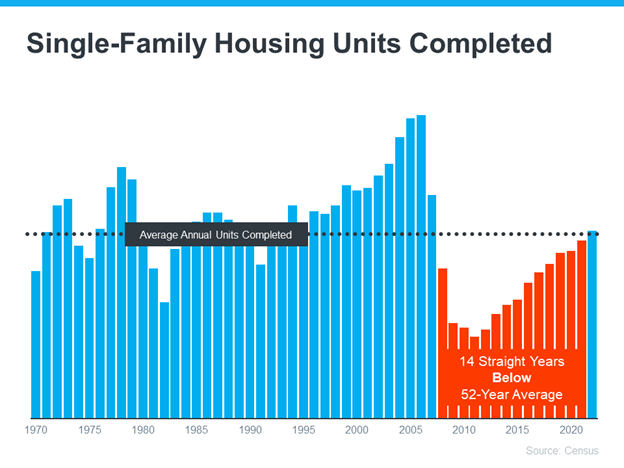
    Low inventory is not a fleeting problem; it has its roots in years of underbuilding. Take a take a look at the historic knowledge on new single-family residence development over the previous a number of many years:

    A 14-year streak of falling wanting historic common development charges has resulted in a persistent deficit in out there properties. While builders at the moment are constructing at a price that meets the historic common, this inventory hole isn’t an issue that may be fastened in a single day.

    The mortgage price conundrum

    Another contributing issue to the present inventory problem is what’s often called the mortgage price lock-in impact. Many owners hesitate to promote as a result of they concern increased mortgage charges on their subsequent residence. This apprehension is affecting potential inventory, as persons are selecting to remain put slightly than danger increased charges.

    However, it is essential to steadiness this monetary consideration along with your private wants for making a transfer.

    How Evergreen’s CashUp Suite of Products could make a distinction

    In markets like these, Evergreen’s CashUp Suite of Products can present a major benefit by providing versatile financing choices that may make your provide extra engaging to sellers. With CashUp, you can act rapidly and decisively, supplying you with the sting in a aggressive market.

    Media-induced concern isn’t any good friend to housing inventory

    Fearmongering by media retailers, speculating on housing crashes or steep declines in residence costs, is additional decreasing the willingness of potential sellers to enter the market. As Jason Lewris, Co-Founder and Chief Data Officer at Parcl, observes:

    “Uncertainty pushed by deceptive info is skewing actual property selections, making individuals hesitant the place they needn’t be.”

    What this implies for you

    For patrons: The shortage of properties compels you to be versatile along with your choices, together with location and sort of housing. A reliable actual property agent can information you thru the method, even suggesting methods to broaden your search if needed. With Evergreen’s CashUp Suite of Products, you could have extra monetary instruments that might tip the scales in your favor.

    For sellers: Low inventory really works in your favor because it makes your property extra noticeable. Now is a wonderful time to seek the advice of an actual property agent who might help you benefit from this distinctive market state of affairs whereas helping you to find your subsequent dream residence.

    Conclusion

    Low inventory is a fancy problem influenced by a myriad of things. If you are considering making a transfer, do not hesitate to hunt skilled recommendation out of your trusted Evergreen lender. Call us right now to study extra about inventory in your space.

    Source: Keeping Current Matters

  • Need to grow your business enterprise with cash, inventory, new making

    Fed holds premiums fixed for the sixth straight time

    By Didier Malagies

    02 May maybe, 2024

    The Federal Reserve ’s Federal Open up Marketplaces Committee (FOMC) managed its small-phrase plan fascination cost steady at a array of 5.25% to 5.5% for a sixth consecutive assembly on Wednesday. “The Committee doesn’t anticipate will probably be preferrred to lower the focus on selection till lastly it has acquired elevated self-confidence that inflation is relocating sustainably towards 2%,“ the FOMC mentioned in a assertion. “In addition, the Committee will go on chopping down its holdings of Treasury securities and company private debt and company mortgage‑backed securities.“ Through their earlier meeting in March , policymakers indicated that they however envisioned just a few rate of interest cuts in 2024. But with inflation remaining sticky and unemployment retaining beneath 4%, these anticipations have gotten a lot much less almost certainly. Modern monetary data hasn’t provided the Fed confidence that inflation will go on to drop. Robust inflation data within the initially quarter, coupled with a strong labor business , have postponed anticipations for the first Fed value slice. In April, Fed Chairman Jerome Powell, talking on the Washington Discussion board , made it clear that cost cuts weren’t imminent due to the power of the monetary system. The financial system has preserved shocking momentum regardless of the present stage of brief-phrase prices. With the unemployment payment beneath 4%, suppliers are steadily incorporating staff and precise wage growth is observable as inflation eases. Whilst upward actions in inflation are noteworthy, sizeable progress in the direction of the Fed’s 2% goal has been designed. “It’s unlikely that the next plan cost switch might be a hike,” Powell instructed journalists on Wednesday throughout the FOMC’s press assembly. “In get to hike the premiums, we would wish to see persuasive proof that our protection stance isn’t sufficiently restrictive to carry inflation sustainably down to 2% over time. That’s not what we’re seeing on the minute.” Though Powell emphasised the unlikelihood of upcoming cost hikes, he additionally remained imprecise in regards to the Fed’s potential curiosity stage trajectory. “We didn’t see improvement within the initially quarter. It seems that it’ll simply take longer for us to attain that time of confidence,” Powell mentioned. “I actually have no idea how lengthy it should contemplate. … My explicit forecast is that we are going to start to see improvement on inflation this 12 months. I don’t know that will probably be adequate to scale back prices we may have to allow the data lead us on that.” In a new enchancment, the Fed launched an easing of its quantitative tightening coverage. Commencing in June, the charge-location human physique will decreased the roll-off cost of its Treasury securities from $60 billion to $25 billion per thirty day interval. This implies that while the Fed is not going to begin off selling Treasurys in June, it should allow fewer of them to skilled. It is not going to alter its roll-off quantity for home loan-backed securities (MBS), which can proceed to be at $35 billion for every thirty day interval, in accordance to Xander Snyder, senior skilled true property economist at First American. “The FOMC didn’t modify the continuing passive roll-off of its MBS holdings however did notice that any prepayments over and above the persevering with $35 billion cap could be reinvested in Treasuries,” Mike Fratantoni, senior vp and major economist for the Mortgage mortgage Bankers Association, defined in a assertion. “We anticipate home mortgage charges to fall in a while this yr, however not as a lot or as fast as we previously skilled predicted.” In addition, Powell reiterated the Fed’s motivation to carrying ahead the Basel III endgame polices in a approach that’s devoted to Basel and in addition equal to what the jurisdictions in different nations are performing. Due to the very fact the March FOMC meeting, Freddie Mac’s common 30-year fixed house mortgage quantity has larger from 6.74% to 7.17%. Ahead of the long run FOMC convention on June 12, two additional inflation readings are envisioned. “While it’s a danger, I actually don’t contemplate that we’ll see a lot modify in house finance mortgage costs adhering to this Fed meeting, given that the Fed has been inclined to enable the knowledge direct at this section within the cycle,” Realtor.com major economist Danielle Hale defined in a press release. “In purchase to see mortgage mortgage prices drop far more noticeably, the Fed will need to see additional proof that inflation is slowing.”  For homebuyers and sellers, this means that housing affordability will proceed being a significant consideration, doubtlessly driving house purchases in economical marketplaces, predominantly within the Midwest and South, in accordance to Hale.

  • The standoff between homebuyers and sellers With minimal inventory, pricing is important to achievement

    When I got here up with the “savagely unhealthy housing market” label in February of this yr, it was depending on the premise that the housing inflation story that we now have skilled to provide with contemplating that 2020 was a historic operate. It facilitated a extraordinarily unhealthy housing sector in 2020-2021 that grew to become savage in 2022. The main result in was a absence of options for American homebuyers.

    Stock, which has been slipping for yrs, broke to all-time lows in 2020. We didn’t have a seasonal press in inventory in 2020, and issues worsened in 2021. To high all of it off, we began 2022 at all-time lows, forcing bidding movement nearly in every single place till mortgage charges rose. And we’re not conversing about your grandfather’s dwelling finance mortgage costs climbing we went from 2.5% to over 7% in a fairly shorter time period of time.

    Of course, this has introduced again once more some stock, as need weak level often leads to inventory by accumulation. Having mentioned that, as we will see beneath, we’re not once more to the historic norms of 2-2.5 million energetic listings, however at simply 1.28 million right now. 

    This doesn’t point out homebuyers actually shouldn’t have slightly one thing of an edge now: As stock has better and purchasing for energy has pale, the shoppers who’re available are working with so much a lot much less stage of competitors because the bidding wars are ending.

    1 of the required variables I added to my carry out by means of 2020-2024 was to place an efficient price-progress design for this time period to know when the housing sector would get into value inflation difficulties. My mannequin was 23% whole cumulative worth progress from 2020-2024 — if we solely grew at 23% for 5 many years, we’d be okay with wherever wage progress was doubtless.

    Well, that obtained destroyed in solely two a number of years.

    In {the summertime} of 2020, I talked about what might remodel the housing market and it was based mostly totally on the premise that the 10-year produce important to get above 1.94%, which might essentially imply property finance mortgage charges would climb above 4%. It wasn’t a part of my forecast in 2020 or 2021. Having mentioned that, for 2022, part of the forecast was that if world-wide bond yields rose, primarily in Germany and Japan, we might break up the 1.94%.

    Of examine course, an ideal deal way more drama occurred after March of this calendar yr and the 10-year produce acquired to 4%, one factor I used to be not trying to find. Even so, with fee progress and home mortgage costs skyrocketing, the strike to affordability is historic.

    Affordability points, irrespective of of inventory data, and it isn’t a more healthy issue when even the month to month present of stock is under 4 months. I talk about about 4 months of provide an ideal deal given that I feel a nicely balanced market is 4 months, not 6 months. It’s fairly distinctive to get six months of present in The usa for the present property earnings market provided that 1996.

    The solely time this came about was 2006-2011 — the housing bust many years. That had a great deal of pressured providing right into a weaker need time period as credit score obtained tighter in partnership to the necessity curve. This implies the housing growth interval of 2002-2005 had predominant credit score rating tightening, which gained’t happen this time all-around when the subsequent recession hits.

    At this time, we’re at 3.2 months provide, which traditionally is not so much, however that’s up from the latest lows and we’re coping with main affordability difficulties.

    I speak about 2019 stock ranges so much as a result of in 2019 genuine dwelling worth ranges briefly went damaging, exhibiting that you simply don’t want to have to have 6 months moreover of stock to have pricing nice down. In actuality, at a 2019 convention, I used to be so joyful about this that I labeled the chart down under as Excellent Information! Not positive if the viewers agreed with my think about.

    Home finance mortgage premiums went up to 5% in 2018, cooling down the housing trade however nothing in any respect as nicely dramatic for the current residence product sales sector. Obtain software program information was solely detrimental 3 weeks out of the yr. Household costs ebb and move, pricing was working within the feeling that sellers achieved homebuyers to a level.

    Now quick forward to 2022. We have witnessed a considerable fee and fee inflation event with pricing nonetheless climbing and the best mortgage mortgage worth maximize in a single calendar yr in new modern-day-working day historic previous. Unlike 2018-2019 when purchase software program data didn’t budge considerably, we now have skilled a sample of very nicely over 20% year-about-12 months declines on the four-week transferring frequent on this index.

    In the ultimate a couple of months of the yr we will hope some months to clearly present 12 months-above-yr hostile prints of 35%-45% as comps are discovering harder. This is a critical strike to demand. 

    In 2018-2019 the affordability metrics weren’t as awful as individuals imagined. This isn’t the circumstance any longer. This is why I used to be so vocal about price ticket escalation organising in direction of the shut of 2020 and into this 12 months. Even my 2022 price ticket forecast displays a large deceleration of promoting worth development from 20% to as small as 5.2%. My forecast was method too minimal as total stock data early within the yr was method too decrease and costs didn’t go larger until April.

    Now with dwelling mortgage prices above 7% and pricing not staying hostile this calendar yr, homebuyers — at minimal all those that can handle to get hold of a house — have a bonus in sure marketplaces the place inventory is at 2019 levels just because the provide of properties of 2019 to me is a useful market. This is how you need to actually search at housing now.

    When mortgage mortgage costs had been under 4%, the market pricing electrical energy was a lot too highly effective with stock at all-time lows. This is not the situation any extra. Even although total inventory is round all-time lows and we’re heading to begin off 2023 with historically low inventory, it doesn’t signify that pricing doesn’t make a distinction.

    From Altos Investigate:

    So my large takeaway from the savagely unhealthy housing trade of 2022 is that 4%-5% home mortgage prices didn’t do the issues I imagined they might and I imagine that this is why my worth growth forecast of 5.2%-6.7% for 2022 is doubtless to be flawed and far too very low.

    Nonetheless, 5%-6% dwelling mortgage costs did modify the market and now 6%-7% home mortgage premiums are reworking habits in order that we see new itemizing data declining even way more as sellers are contacting it quits on their technique to file. Homebuyers who can qualify for a dwelling now are in a significantly improved place than the sooner couple of a number of years, however hey, you’ve to provide with a big strike to the entire fee of your dwelling. For some homebuyers, it’s not a big provide, however for different individuals, it stings.

    From Real property agent.com:

    Homes which are priced applicable, primarily in elements beneath 2019 inventory ranges, are selling rapidly, and these homes that aren’t priced appropriate to {the marketplace} are utilizing prolonged to present. Sixteen occasions to market is proceed to far too low for my fashion this displays how a lot of the state isn’t again to 2019 levels.

    In a couple of weeks, stock will begin to be affected by seasonality the priority is, will individuals properties which are taking for an extended interval to promote name it quits for the yr? Stock traditionally falls within the fall in winter and rises within the
    spring and summertime. However, with weak spot in want, stock can accumulate.

    The previous time total inventory grew was in 2014 as a result of we had weak want. Acquire software program data was down on typical 20% 12 months over yr, and altering to the inhabitants was probably the most reasonably priced stage within the index ever. In 2014 we proceed to had the seasonal dive in inventory within the slide and wintertime, so time will notify if that would be the case another time with the rise in inventory this yr.

    My premise beforehand within the yr of total inventory data having again once more to 2019 phases in 2023 is hitting a snag with the lower in new listings, in order that is something we actually are not looking for to see for the spring of 2023. To have a balanced housing market, we require full of life listings to rise yearly, which they generally do 2020 was an anomaly. We shall see what the long run few months convey for housing nonetheless, as we close to the publications for 2022, we will concur it was a savagely unhealthy housing market.


    What we don’t need to be in 2023 is trapped with low entire stock — sellers not wanting to provide, homebuyers and sellers battling greater than worth, and sellers getting cussed about it. With extra inventory, sellers have to be a lot much less stingy this is why I’m a fanatic of acquiring full stock data again to 2019 ranges.

  • Very low inventory a challenge to housing industry as charges drop

    Mortgage mortgage charges declined for the third consecutive 7 days, sparking hope for a superior homebuyers’ spring yr. But while charges have dropped, the housing market place has continued to be challenged by small inventory ranges. 

    Freddie Mac’s Primary Mortgage mortgage Industry Survey confirmed on Thursday that the 30-yr preset-price mortgage mortgage was 6.32% as of March 30, down 10 basis factors from the earlier 7 days, largely owing to the financial uncertainty led to by lender collapses. The survey reveals the same charge was 4.67% a calendar yr up to now. 

    “Over the earlier a variety of weeks, declining charges have introduced debtors once more to the industry however, as the spring homebuying interval will get underway, small inventory continues to be a key challenge for potential clients,” Sam Khater, Freddie Mac’s chief economist, defined in a assertion. 

    Altos Research information shows that the weekly inventory fell from 414,278 on March 17 to 413,169 on March 24. 

    “As the important thing spring buying yr can take off and the perfect time to promote attracts shut to, potential consumers will probably be looking for for very well-priced, prepared-to-go-in homes,” Hannah Jones, Realtor.com’s financial info analyst, stated in a assertion. “Spring sellers ought to begin getting their dwelling fully prepared on the market, protecting in mind that it took lengthier than anticipated to prep.”   

    Surging charges forward? 

    Irrespective of the 7 days-in extra of-week lower, mortgage charges begun to tick up but once more across the previous few occasions. 

    At HousingWire’s Mortgage Fees Heart, the Optimal Blue information exhibits the 30-12 months conforming property finance mortgage price at 6.44% on Wednesday, down from 6.47% the prior Wednesday. Having stated that, the very same cost was 15 foundation particulars higher in distinction to closing Friday.

    At Mortgage News Daily, charges had been at 6.61% on Thursday afternoon, up a particular person basis challenge from the previous closing and 23 bps from 6.38% compared to Friday. 

    According to property finance mortgage price observers, buyers pushed the ten–yr Treasury yield up over the ultimate couple of occasions as they shifted absent from bonds to different choices as a result of the uncertainty within the economical sector waned. Property finance mortgage costs, immediately correlated to the U.S. treasuries, enhanced within the interval.

    “The 10-year yield has been caught in a differ for 2023, and as the disaster slowed down in phrases of headlines, the bond industry channel stayed in line,” Logan Mohtashami, lead analyst at HousingWire, talked about. 

    “The spreads amongst the 10-year generate and the 30-yr mortgage have gotten pressured thanks to the catastrophe. So, even whereas mortgage charges fell previous 7 days, they swiftly reversed as the 10-year generate bounced greater this 7 days,” Mohtashami included. 

    Regional banks that endured a liquidity disaster due to to a deposit function have been given support by the use of a sale or a revenue infusion. First Citizens Bank acquired Silicon Valley Lender, and Flagstar Bank assumed most deposits and chosen property of Signature Bridge Lender. In addition, 11 U.S. banking establishments constructed $30 billion in deposits at First Republic Financial establishment. 

    On Thursday, the generate for the 10-12 months Treasury was at 3.56%. Mohtashami’s forecast for 2023 is for the 10-year generate to proceed being between 3.21% and 4.25%, this implies home mortgage charges ought to be between 5.75%- 7.25%, assuming the spreads ended up large.


  • Housing inventory nevertheless near report lows


    We solely have 2.6 months’ really price of housing inventory within the U.S. quickly after coming off the solitary most vital house-profits crash calendar 12 months in background. That is during which we’re nowadays in The us. As anticipated, current property gross sales fell from February to March because the earlier month’s report was highly effective.

    We have a workable fluctuate for 2023 revenue within the current residence product gross sales market amongst 4 million and 4.6 million. If we’re trending underneath 4 million — a chance with new itemizing information trending at all-time lows — then we have now a lot weaker demand from clients than people think about. Now if we get a handful of income prints greater than 4.6 million, then demand is much better than the primary bounce we had earlier within the yr.

    To get again once more to the pre-COVID-19 product gross sales array, we have to must see present residence income growth between 4.72 – 5.31 million for not less than 12 months. That shouldn’t be occurring. We are working from a really low bar, and as I’ve burdened in extra of the yrs, it’s sporadic article-1996 to have an everyday month-to-month income growth beneath 4 million. In the chart underneath, with the crimson traces drawn, you possibly can see how totally different the revenue crash in 2022 was compared to the ultimate two conditions charges rose and revenue fell.

    From NAR: Overall existing-property gross sales – completed transactions that incorporate single-household homes, townhomes, condominiums, and co-ops – fell 2.4% from February to a seasonally adjusted annual charge of 4.44 million in March. Year-in extra of-calendar 12 months, revenue waned 22.% (down from 5.69 million in March 2022).

    Previous 12 months we had a considerable income drop for the current home revenue market, which acquired worse because the calendar 12 months progressed. When looking at year-more than-year particulars for the remainder of the calendar 12 months, we have now to keep in mind that the calendar year-in extra of-year income declines will enhance simply given that the comps will get easier. That will select up velocity in direction of the second half of 2023 and we might see some optimistic 12 months-around-calendar 12 months particulars in direction of the end of the calendar 12 months. 

    NAR: 12 months-around-calendar 12 months, revenue waned 22.% (down from 5.69 million in March 2022).

    An individual half I didn’t prefer to see on this report is that the times on sector fell and are again to beneath 30 instances. This is the fact of our world: full energetic listings are nonetheless within the neighborhood of all-time lows and demand from clients so significantly has been regular since Nov. 9, 2022.

    As we are able to see within the particulars beneath, the instances in the marketplace fell once more right down to 29 instances. I hope that it doesn’t go decreased than this. For some historic context, again once more in 2011, this information line was 101 days.

    NAR: 1st-time potential consumers ended up liable for 28% of income in March Particular particular person merchants acquired 17% of residences All-funds product gross sales accounted for 27% of transactions Distressed income represented 1% of income Homes sometimes remained on the sector for 29 instances.

    When I discuss stabilization in want on condition that Nov. 9, I’m looking out at order software info since that day, and — excluding some trip months that I don’t place any weight on —we have now had 15 constructive prints versus six detrimental prints in that point. So, whereas the chart underneath doesn’t seem like what we noticed within the COVID-19 restoration, it has stabilized.

    I set essentially the most physique weight on this information line from the second week of January to the to start out with week of May. Right after May, often speaking, total volumes ordinarily drop. Now, write-up-2020, we have now had 3 straight a very long time of late-in-the-12 months runs on this details line to mess something up. Nonetheless, sticking to my previous work, I’ve seen eight constructive prints versus six detrimental prints this 12 months. So, I’d not join with this a booming demand thrust elevated, only a stabilization interval making use of a decreased bar.

    NAR: Total housing inventory registered on the finish of March was 980,000 models, up 1.% from February and 5.4% from an individual 12 months up to now (930,000). Unsold inventory sits at a 2.6-thirty day interval provide at present product sales tempo, unchanged from February however up from 2. months in March 2022.

    Complete housing inventory, though up calendar 12 months about yr, is nevertheless near all-time lows, and month-to-month provide can also be up 12 months round 12 months. On the opposite hand, as everyone knows, housing inventory reached an all-time very low in 2022, so it’s important to have context when chatting in regards to the calendar year-around-year particulars. As we are able to see beneath, from 2000, full energetic housing inventory rose from 2 million to 2.5 million earlier than we noticed the large stress spike in present from 2005 to 2007.

    The NAR info seems to be a bit backward, so if you need way more refreshing weekly data, I write the Housing Industry Tracker each week on Sunday night to present you that particulars.

    One factor greater mortgage charges have performed for constructive is that house-price development is cooling down noticeably contemplating that the large spike in costs. That growth shouldn’t be cooling as considerably as I would love, tied to my many years 2020-2024 cost-expansion product for a safe housing sector. Nonetheless, I’ll get what I can get at this place.

    NAR: The median present-household worth for all housing varieties in March was $375,700, a decline of .9% from March 2022 ($379,300). Cost climbed marginally in three areas however dropped within the West.

    The most stunning info we have now considered within the housing present market contemplating that the large crash in residence revenue is how decrease inventory nonetheless is within the U.S. — aside from for all these learning HousingWire or listening to the HousingWire Daily podcast.

    Keep in thoughts, inventory channels are varied now just because credit score historical past channels within the U.S. are distinct article-2010. Also, demand has stabilized as a result of Nov. 9, so once we converse about housing within the U.S., let’s use the info that makes notion.