Tag: institutions

  • MPA opens annual broker study on Australia’s non-banking institutions

    MPA opens once-a-year broker study on Australia’s non-banking firms | Property finance mortgage Expert Australia

    Information

    MPA will expose the very best non-financial establishment mortgage mortgage lenders as picked by brokers

    MPA opens annual broker survey on Australia's non-banks

    Non-financial establishment dwelling finance mortgage mortgage suppliers hold a near-operating romance with brokers to make completely positive that prospects are supplied the best potentialities, wherever they’ve an achieve of their potential to embrace customers not favoured by banking institutions.

    MPA is trying to brokers once more to uncover which non-lender lenders are the very best at furnishing knowledgeable providers – Brokers on Non-Banks 2024 is now open up for feedback.

    The study offers a helpful alternative for brokers to share their views on which mortgage firms have stood out all through numerous requirements, these sorts of as turnaround time, BDM assist and credit score rating plan.

    The study will shut on Friday, July 26.

    MPA is completely satisfied to lover with One explicit Tree Planted and have reforestation as an integral facet of our enterprise design. For every particular person response to the survey, a tree will likely be planted as ingredient of our dedication to sustainability.  

    Brokers on Non-Banking firms 2024 will likely be printed in concern 24.05 of MPA journal and on-line in October.

    Associated Posts

    No value e-publication

    Our every day e-newsletter is Free and retains you as much as day with the planet of dwelling mortgage.
    Make positive you whole the sort underneath and click on on on Signal UP to acquire every single day e-newsletters from House mortgage Specialist Australia.

    Our every day publication is Absolutely free and retains you updated with the world of home mortgage.

  • SCOTUS axes use of in-home judges, a get for financial institutions accused of negative acts

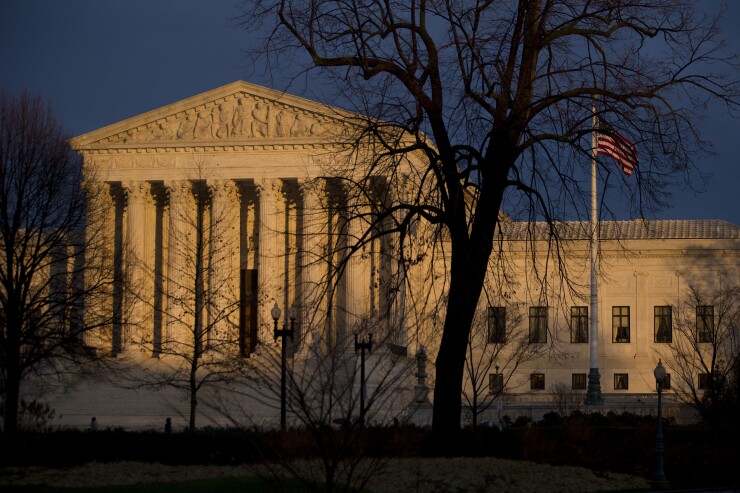
    U.S. Supreme Court building The Supreme Court’s 6-3 selection in a situation involving the Securities and Trade Fee hinges on Seventh Modification of the U.S. Structure, which enshrines the fitting to a jury demo specifically circumstances.

    Andrew Harrer/Bloomberg

    The U.S. Supreme Court docket put new limitations Thursday on the use of in-property judges in regulatory enforcement situations — a watershed conclusion that’s predicted to revenue each banking corporations and private bankers in circumstances through which their regulators have accused them of wrongdoing. 

    Next the 6-3 willpower, heaps of enforcement situations that federal companies would in any other case herald administrative laws courts —  the place, defendants regularly argue, the regulators have a homefield profit — will very probably must be filed in federal courtroom. The Seventh Modification of the U.S. Constitution enshrines the correct to a jury trial in certain circumstances.

    The ruling by the upper courtroom’s conservative bulk grew out of a fraud scenario that the Securities and Exchange Fee submitted from the founder of a hedge fund. But it has large implications for a broad vary of federal corporations.

    In the banking sphere, the Federal Deposit Insurance Corp, the Federal Reserve, the Business of the Comptroller of the Forex and the Consumer Economic Security Bureau all use administrative laws judges.

    Some of the clearest repercussions of the ruling within the banking realm, consultants defined, will comprise situations the place by regulators are wanting for civil financial penalties from both financial institutions or women and men. All these situations will now must be introduced in federal courtroom docket.

    David Zaring, a professor of approved research and firm ethics on the College of Pennsylvania’s Wharton School, talked about that quite a few enforcement situations are settled as a substitute than go to trial. He said that the prospect of a high-priced battle in federal courtroom might give extra leverage to defendants who’re engaged in settlement talks with regulators.

    “Federal courtroom docket litigation is pricey, and that might weigh into the leverage defendants have when questioning about regardless of whether or not to settle cases involving civil financial penalties,” Zaring claimed.

    He cited three examples of the varieties of conditions the place by the defendants possible would have had a stronger hand to get pleasure from in settlement talks if the Supreme Court’s ruling Thursday skilled now been in affect.

    Underneath that situation, securities fraud cases which were launched in direction of large banking corporations following the 2008 fiscal disaster, anti-money-laundering cases that resulted in substantial banking corporations paying out penalties and situations involving financial establishment staff’ use of unauthorized messaging apps, might properly have been fastened on extra favorable situations for the banks, Zaring mentioned.

    The penalties in individuals settlements have normally stretched into the tons of of tens of hundreds of thousands of kilos, if not extra than $1 billion.

    The implications of Thursday’s ruling are much less crystal clear for enforcement situations that don’t comprise civil earnings penalties, in accordance to specialists.

    Banking organizations might convey situations, for illustration, looking for restitution or the disgorgement of sick-gotten good points. They might probably take a look at to bar women and men from doing the job within the banking trade. They might additionally search for an purchase that a particular financial establishment necessities to stop and desist from specific conduct. 

    An enforcement situation involving disgorgement might nonetheless go earlier than an administrative regulation decide, Zaring defined Thursday, based totally on his wanting by means of of the Supreme Court’s choice.

    David P. Weber, a earlier enforcement official on the OCC, the FDIC and the SEC, agreed with that interpretation of the courtroom’s willpower. But he extra that provisions of the Federal Deposit Insurance Act giving lender regulators the talent to hold situations not involving civil income penalties proper earlier than an administrative laws select can even very probably be challenged in courtroom docket.

    “I’m optimistic that intrepid litigants are actually more likely to downside all of the provisions,” defined Weber, who’s now a professor at Salisbury University’s Perdue University of Business enterprise.

    Weber additionally pointed to an extra issues the ruling brings about for financial institution regulators. He mentioned that present federal rules don’t assist the banking companies to hold certain sorts of enforcement conditions — for working example, all these alleging that a financial establishment engaged in unsafe and unsound methods — in federal courtroom.

    If the courts now simply take the place that such circumstances must be introduced in federal courtroom, as a substitute than upfront of an administrative laws decide, Weber claimed: “Until lastly Congress provides a take care of, it could maybe be fairly difficult for federal banking corporations to convey enforcement steps.”

    Weber was vital of the Supreme Court’s remaining determination, arguing that administrative regulation judges have know-how about banking that federal judges absence.

    Protection authorized professionals are ordinarily a lot far more essential of administrative regulation judges and the principles of the executive regulation technique, which absence specific procedural protections that federal courts present to defendants.

    “From my perspective as a safety legal professional, I normally favor to be previous to a federal jury than an administrative regulation select,” said Brad Bondi, a trial lawyer at Paul Hastings.

    Bondi reported that the Supreme Court’s selection Thursday restored a pillar of American justice, which is that defendants who facial space an SEC penalty are entitled to a jury trial.

    “This is a landmark remaining determination that has huge ramifications throughout different govt businesses that use administrative proceedings,” he reported.

    The courtroom’s feeling was penned by Main Justice John Roberts and joined by Justices Clarence Thomas, Samuel Alito, Neil Gorsuch, Brett Kavanaugh and Amy Coney Barrett.

    “A defendant going through a fraud go properly with has the proper to be tried by a jury of his buddies earlier than a impartial adjudicator,” Roberts wrote.

    In a concurring feeling, Gorsuch, who was joined by Thomas, wrote that the close to relationship amongst administrative regulation judges and the organizations that convey enforcement circumstances makes it difficult, if not not potential, to convey the image of impartiality.

    “Sure, ALJs love some consider of independence as a matter of regulation and statute from the authorized professionals who go after bills on behalf of the company. But they keep servants of the very same be taught — the fairly company tasked with prosecuting people …” Gorsuch wrote.

    In a fiery dissent, Justice Sonia Sotomayor accused the courtroom’s conservative the better half of participating in a “electrical energy seize” by “arrogating Congress’s policymaking job to itself.” She wrote that the constitutionality of tons of of federal laws might now be in jeopardy, and that dozens of corporations might be stripped of their electrical energy to implement laws that Congress has handed.

    “The overwhelming majority pulls a rug out from beneath Congress,” Sotomayor wrote in an feeling joined by Justices Elena Kagan and Ketanji Brown Jackson, “with out even acknowledging that its determination upends above two tons of of years of settled govt observe.”

  • Monetary hardship: Banking institutions do ‘higher job’ than nonbanks, states ABA

    Financial hardship: Banking firms do ‘higher job’ than nonbanks, suggests ABA | Australian Broker News

    News

    Economical hardship: Banking firms do ‘higher job’ than nonbanks, suggests ABA

    ASIC slams lenders’ cash hardship techniques, associations reply

    Financial hardship: Banks do 'better job' than nonbanks, says ABA

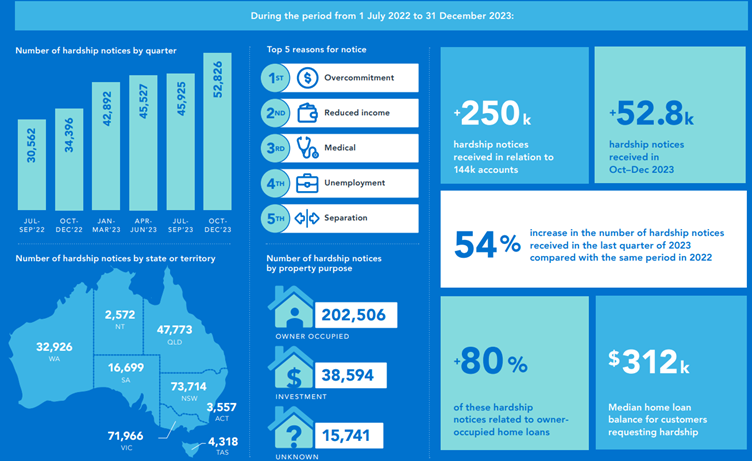
    The Australian Banking Association (ABA) has responded to an ASIC economical hardship evaluation of 10 massive residence collectors, which noticed they need to actually be finishing up further to help Australians who’ve been struggling to satisfy their repayments.

    The report noticed that some lenders had manufactured accessing economical help so troublesome that much more than one in a number of (35%) Australians dropped out of the software program course of at minimal when.

    The report additionally discovered 40% of customers who acquired hardship assist by the use of discount or deferral of funds, fell into arrears splendid quickly after the help time frame completed.

    On the opposite hand, ABA CEO Anna Bligh (pictured) defended the steps of banking institutions.

    “Every one week banking firms help a whole bunch of Australians in monetary hassle with a array of life like instruments together with restructuring loans to minimize repayments, shifting people to curiosity-only preparations or most definitely deferring funds for a interval,” she talked about.

    ASIC’s consider into lenders economical hardship procedures

    ASIC then undertook a data choice involving 30 vital lenders and launched this report simply after inspecting 10 big home mortgage suppliers to comprehend their technique to financial hardship.

    This guidelines of mortgage firms included each equally banking institutions and nonbanks, equivalent to:

    As increasing numbers of Australians battle with worth tag-of-dwelling pressures, ASIC Chair Joe Longo mentioned, “In the worst situations, lenders disregarded hardship notices, successfully abandoning prospects who wanted their assist and had been being not convention neighborhood expectations.

    “For of us who get to out to their mortgage firm to signal they want help, this may be devastating,” Longo mentioned. “Too a lot of Australians in financial hardship are acquiring it exhausting to get help from their collectors and it’s time for significant enchancment.”

    All spherical, the report uncovered 4 overarching themes:

    &#13
    Creditors didn’t make it easy for purchasers to present a hardship see&#13
    Evaluation procedures had been usually difficult for purchasers&#13
    Loan firms didn’t join proficiently with customers&#13
    And susceptible prospects usually weren’t very nicely supported.&#13

    The ASIC chair reported mortgage suppliers “should enhance” the best way they provide with purchasers going by means of hardship and “is not going to hesitate” to take enforcement movement wherever right.

    Financial hardship: Crunching the small print

    Whilst ASIC’s report could seem dire, it did current some encouraging data for fiscally harassed prospects in protection of the lenders’ steps.

    Bligh claimed purchasers who’re expertise the pinch financially should take coronary coronary heart from the purpose that the report finds that 94% of all carried out functions for support ended up licensed.  

    Although solely 71% of all authentic hardship requests have been accredited, this vary jumps to a an ideal deal elevated 94% for individuals who full the whole utility system.

    This is just because some prospects (23%) withdraw their software program or are unsuccessful to present the essential data. As a finish end result, the real denial cost for completed functions is simply 6%.

    Also, though the report reported that 35% of individuals dropped out of hardship functions, it didn’t outline the nice explanation why.

    People right this moment could presumably not proceed with a hardship software program due to a wide range of explanations, these sorts of as scenario altering or they no prolonged important the assistance. Equally, they might nicely have simply positioned the system a lot too difficult.

    “Banks have longstanding preparations in put to assist folks experiencing financial issues, equivalent to actually educated and devoted hardship teams ready to help shoppers,” reported Bligh.

    ASIC additionally talked about collectors engaged constructively by means of the critique and acknowledged the price of supporting purchasers encountering economical hardship.

    At least seven of the ten collectors skilled “vital methods underway” to make enhancements to their answer to cash hardship, in accordance to the regulator.

    Some had been commencing or rising their enchancment programs and most recognised that even additional perform is important to make sure they commonly help their purchasers experiencing monetary hardship.

    On the opposite hand, ASIC Commissioner Alan Kirkland, whose remit incorporates assist for susceptible shoppers, claimed collectors had been nonetheless not “placing customers entrance and centre” of their tactic to financial hardship.

    “Many mortgage suppliers should not getting their prospects’ distinctive predicaments into consideration, as an alternative supplying a standardised ‘one-dimension-matches all method’, which isn’t convention prospects’ calls for,” Kirkland said.

    “We encourage folks frightened about creating repayments to name their monetary establishment and if not proud of the response, to lodge a grievance with them.”

    Are nonbanks the worst culprits?

    Curiously, the report distinguished a distinction between banking institutions and nonbanks in how they tactic financial hardship eventualities.

    When the procedures of the collectors reviewed “various considerably”, ASIC positioned in regular monetary institutions carried out higher than nonbanks and larger monetary institutions carried out higher than lesser banking firms.

    Nonetheless, it however acknowledged gaps within the steerage furnished by all mortgage suppliers.

    “We are impressed to note that the report finds that banks do a a lot better job than non-lender collectors and banking firms will proceed on to attempt to present their purchasers the perfect doable firm,” talked about Bligh.

    For their portion, a spokesperson from the Australian Finance Sector Affiliation (AFIA), which signifies each equally monetary institutions and nonbanks, talked about it’s inspecting ASIC’s outcomes into financial hardship strategies.

    “We will proceed to perform with associates to spice up the methods they’ve in put, ensuring they meet the evolving wishes of customers as expense-of-living pressures proceed on to extend,” the AFIA spokesperson said.

    ABA additionally claimed its associates would consider the conclusions and work with ASIC on any extra methods to assist shoppers.

    “In any organisation, there’s consistently space for development,” Bligh said. “Banks stand ready help to purchasers.”

    “That’s why the ABA has been jogging its ‘don’t troublesome it out by yourself’ marketing campaign, urging prospects experiencing monetary stress to entry out to their financial institution and get help.”

    “The earlier people obtain out to their financial institution, the more easy and extra shortly it’s for banking institutions to put help decisions in place.”

    Connected Tales

    Preserve up with the latest data and capabilities

    Be part of our mailing itemizing, it’s cost-free!

  • Financial institutions remaining in limbo as regulators mull route forward for Basel

    Barr Gruenberg Federal Reserve Vice Chair for Supervision Michael Barr and Federal Deposit Coverage Corp. Chair Martin Gruenberg are high the drive for massive financial institution money reform, together with performing Comptroller of the Forex Michael Hsu.

    Anna Rose Layden/Bloomberg

    Washington’s controversial cash proposal is on preserve indefinitely as regulators work out a possible route forward for the reform provide. In the meantime, the banking sector continues to be left in limbo. 

    Improvements are coming to the so-named Basel III endgame — which might improve cumulative funds calls for for substantial monetary institutions by 16%  — however irrespective of if regulators modify the current proposal or unveil a wholly new supplying continues to be to be discovered. 

    Based on the tack taken by the Federal Reserve, the Federal Deposit Insurance protection Corp. and the Place of labor of the Comptroller of the Currency, adopting new funds guidelines may get anywhere from a pair months to completely above a 12 months. And their distinct alterations may final result in an unlimited number of outcomes. 

    For banking firms keen on altering their small enterprise merchandise and concord sheets to satisfy regulatory necessities as quickly as potential, this uncertainty suggests possessing to prepare for all choices.

    “Our institutions do not know what the trail forward is, so they’re prone to run on the idea of remaining ready for whichever outcomes may occur,” defined Kevin Fromer, president and CEO of the Money Products and companies Forum, a commerce staff for the eight largest banking firms in the nation. “Buyers count on our associates to fulfill regulatory proposals lengthy previous to they’re utilized, and so they as a outcome should be able to deal with their cash in keeping with the best info that they’ve.”

    Francisco Covas, authorities vice chairman and head of examine on the banking commerce group Lender Coverage Institute, talked about the group began advising its clients to retain earnings and purchase different preemptive methods when the proposal was issued final summer season.

    The consensus try is that the final mannequin of the rule — having stated that it’s attained — will embody decreased capital wants than in the unique put together. But, Covas acknowledged the uncertainty suggests banking firms should be conservative till they know the way and when these modifications are potential to contemplate outcome.

    “Until this will get mounted in circumstances of the timing, companies will probably be cautious on how they’re prone to deploy funds and think about benefit of prospects that crop up,” he acknowledged. “We are eager to know far more particulars and particularly wherever factors will inevitably land.”

    Fed Chair Jerome Powell promised “vast and supplies” changes throughout congressional testimony in March. He additional that he can be open to issuing a brand new proposal, if the diploma of alter warranted this form of a go.

    Previous 7 days, Powell claimed the central lender stays absolutely commited to using the worldwide benchmarks agreed upon by the Basel Committee on Banking Supervision in 2017. He additional that the proposal is the company’s main regulatory precedence, however stated the Fed’s board of governors has not settled on a program of motion.

    “We have not constructed any alternatives on coverage or on methodology in any respect, nothing — no alternatives have been created,” Powell talked about all by way of his put up-Federal Open Current market Committee push assembly. “I’ll say but once more, although, if we conclude that reproposal is good, we might not wait to insist on that.”

    The FDIC and OCC declined to touch upon the rulemaking course of this 7 days. 

    Company rulemakings are dominated by the Administrative Method Act, which calls for coverage alterations to be put as a results of a so-known as discover and remark process for the general public to weigh in on the proposal and voice worries. Businesses ought to then take in this commentary, reply to it and, the place by acceptable, use it to amend the closing mannequin of a rule. 

    Changes manufactured to remaining guidelines should be a “rational outgrowth” of what was in the genuine proposed rule. Several in and throughout the banking sector argue that the enhancements needed for the Basel III endgame proposal exceed this regular, and therefore a wholly new rule ought to actually be set by the use of its have detect and remark interval. 

    “The rule want to enhance significantly supplied the fears elevated by a broad spectrum of industries and firms, the envisioned have an effect on on the financial local weather, the complexity of the rule, as properly as the impacts it has on different sections of the cash framework and regulation,” Fromer defined. “With most of these substantial enhancements anticipated, the enterprise and different intrigued events ought to actually be outfitted to know all these enhancements and touch upon them to make completely positive there aren’t unintended repercussions. That can be a smart means forward for a rule that has elevated extremely substantive points and many system points as successfully.”

    Other people say the regulators have an enormous berth for creating enhancements beneath the cheap outgrowth doctrine. 

    Jeremy Kress, a regulation professor on the College of Michigan and a former Fed legislation agency, reported companies are offered vast deference on what’s a rational outgrowth. He additional that the way in which regulators approached the Basel III endgame — by which embody 174 particular queries and alternate options for some provisions — gave them sufficient latitude to make enhancements with out the necessity of attending to repropose.

    “As lengthy as they’re in the realm of chance-centered cash working with credit score historical past danger, operational hazard and sector hazard, the companies have opened these frameworks for most of these broad remark and have obtained this sort of vast comment and on all components of people difficulties, that they’ve a really substantial amount of leeway in going straight to a remaining rule,” Kress reported.

    The Fed, FDIC and OCC obtained much more than 400 letters concerning the Basel III endgame for the period of an prolonged remark time interval of virtually six months. Even in the course of typical rulemakings, the consider method usually takes fairly a number of months. But not solely has the Basel III endgame proposal acquired additional opinions than traditional, the commentary can also be decidedly simply one-sided, with 97% of responses turning into antagonistic, in keeping with evaluation by the regulation group Latham & Watkins.

    Shayna Olesiuk, director of banking protection for the customer advocacy group Superior Marketplaces, talked about the intensive opposition has contributed to a story in and throughout the banking sector that reproposal is required. In actuality, she acknowledged, a whole lot of of the problems might be addressed by creating minor changes to the proposal.

    “In quite a few methods, the quantity of opposition to the proposal does expertise like new territory,” Olesiuk claimed. “But regardless of this, we should always actually not and are unable to remove emphasis on the a number of essential advantages of the rulemaking for the American women and men, like economical safety and elevated lending by way of the ups and downs of the financial cycle.”

    Improvement of the Basel III endgame — be it finalization or reproposal — appears to hinge on the Fed governors arriving at what Powell has described as a “consensus” perspective on easy methods to go forward. This in all probability suggests the up coming version of the proposal should safe assist from Powell and Fed Vice Chair Philip Jefferson, each of whom voted in favor of the unique model final July however with main reservations. Two different board associates, Govs. Michelle Bowman and Christopher Waller, voted versus the proposal and proceed to be against it.

    At the time of the proposal, Powell noticed many areas that he want to see suggestions on, just like the proposal’s results on money markets and operational danger administration. He additionally flagged the truth that the proposal exceeds the conventional set by the Basel Committee and equal reforms at the moment being considered by regulatory businesses throughout the setting — some extent he reiterated final 7 days, noting that the rule should be “reliable to Basel and likewise equal to what the opposite substantial comparable jurisdictions are finishing up.”

    Jefferson has shared variety of opinions on the proposal because of the reality it was launched ultimate summer season season. But, on the time, he expressed drawback concerning the framework’s impression on the banking sector and the broader monetary state. 

    Olesiuk, a earlier deputy director for deposit protection and hazard analysis on the FDIC, reported there are quite a few methods for regulators to tweak the proposal with out having touching its most important elements.

    “Generating adjustments on the credit score facet can be an inexpensive trade-off to take care of issues like operational and market place menace, that are significantly additional important in magnitude and materially bolster the funds framework,” she defined.

    Some say the operational changes — exactly the shift away from banking institutions staying ready to make use of inner designs to standardized varieties for calculating capital wants — are essentially the most onerous in the proposal and should be altered. 

    Other analysts have identified that changes may very well be designed to cut back the whole funds load of the reform. These might encompass amending the surcharge proposal for worldwide systemically important banking firms, or GSIBs, that was put out together with the Basel III reform or dropping the fear funds buffer prerequisite from the lately expanded danger-dependent technique.

    Regardless of what trade-offs are made internally inside the businesses, the final model of the rule — irrespective of if it comes in a while this calendar yr or additional down the road — will probably be vastly scrutinized by the banking enterprise, which has expressed a bigger willingness to sue its regulators in new years.

    “I hope and expect that the banking businesses need to get this carried out and need to get it executed in a means which goes to defend it from market points,” Kress reported.

  • Regulators challenge direction to community financial institutions on third-celebration threats

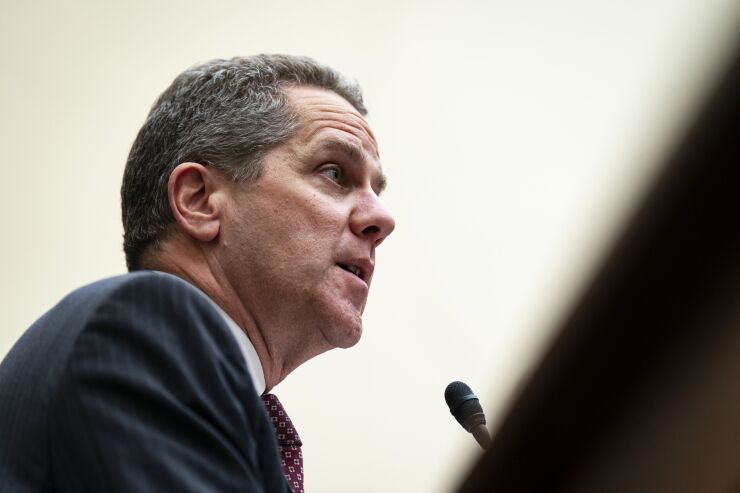
    Michael Barr Michael Barr, vice chair for supervision on the Federal Reserve, talked about in January that banks’ reliance on third-occasion suppliers for companies produces “the chance for higher cyber threat.” The Fed, Business of the Comptroller of the Forex and Federal Deposit Coverage Corp. issued a joint help Friday on Third-get collectively hazard for community financial institutions.

    Bloomberg Information

    Federal regulators have issued contemporary pointers for a way community banking firms ought to care for hazards associated to Third-parties.

    The Federal Reserve, Federal Deposit Coverage Corp. and the Office atmosphere of the Comptroller of the Forex issued a 30-web web page guidebook on Friday describing how tiny financial institutions actually ought to strategy all phases of their exterior partnerships, from planning to due to diligence, settlement negotiation to ongoing oversight and, finally, termination. 

    “Third-get collectively associations current diversified pitfalls that neighborhood banking firms are anticipated to correctly acknowledge, consider, observe, and command to make sure that their capabilities are carried out in a protected and audio method and in compliance with relevant legal guidelines and polices,” the company claimed in a joint assertion. “These authorized tips and guidelines comprise, however will not be restricted to, people constructed to defend folks and people folks addressing economical crimes.”

    The publication elaborates on the official help issued by the Fed, FDIC and OCC remaining June. It doesn’t introduce new expectations however presents exact points and supply supplies for every particular person of the previous confirmed guidelines. It additionally contains illustrative examples of how they might be set into apply.

    The report notes that failing to appropriately handle third capabilities might expose banks to cash losses or different risks, and will consequence in harm to patrons. 

    The modern steering is the most recent transfer by the Washington firms to remind banks that they’re on the hook for factors non-financial establishment associates and assist distributors do on their behalf. 

    “Reliance by financial institutions on third-bash assist distributors has developed considerably in present a number of years, and with that reliance comes the potential for higher cyber likelihood,” reported Fed Vice Chair for Supervision Michael Barr in the midst of a speech in January. “It is in the long run the accountability of financial institutions to take care of their Third-occasion hazard, and now we have traditionally seen gaps on this regard.”

    Friday’s report notes that the ideas isn’t relevant fully to group banking firms and could possibly be a place of reference for a lot bigger institutions, as nicely.

    Usually, extra compact banking firms have been extra apt to accomplice with exterior teams — these kinds of as financial applied sciences companies — to bolster their corporations that their bigger counterparts. Banking-as-a-company preparations, by which fintechs procure patrons for deposit, credit score historical past or lending options facilitated by a chartered lender, have been hotbeds for supervisory motion through the previous 12 months. 

    The recommendation isn’t distinctive to BaaS preparations, though. It additionally notes essential points for important services suppliers — some factor else quite a lot of scaled-down banking institutions outsource — fraud administration and computing skills.

    In March, Performing Comptroller of the Currency Michael Hsu acknowledged the companies had been being considering a proper rule that might combine third-bash likelihood administration into a brand new operational likelihood framework. 

    He talked about that the enlargement of financial establishment partnerships has designed much more openings for hazard to creep into the banking methodology.

    “The provision of banking options more and more resembles world manufacturing provide chains, with their efficiencies, complexities and vulnerabilities,” Hsu acknowledged. “The threat floor space for disruptions expands, and as authorities in different jurisdictions begin off using their laws to ensure operational resilience, we’re evaluating and doing the job with our interagency associates to create the appropriate method on this article within the U.S.”

  • How major banking institutions stabilized home loan earnings even with volume slipping

    Huge monetary institutions kicked off the earnings season with some early-yr weak spot in situations of the amount of housing finance train, however there have been some shiny locations of their mortgage loan ultimate outcomes.

    Some of the margins on monetary loans have been being greater within the first quarter, and that contributed to stabilized dwelling lending money circulation even at Wells Fargo, which introduced an exit from the correspondent channel ultimate calendar yr and noticed a particularly steep drop in amount.

    Obtain-on-sale margins for mortgages improved for every Wells Fargo and JPMorgan Chase on a quarter-to-quarter foundation and outpaced anticipations, a report from Keefe, Bruyette & Woods mentioned.

    Wells recorded a 287 basis-issue consecutive-quarter GOS acquire. Even although which may not be indicative of broader tendencies because of a particularly low amount within the former fiscal time interval and another idiosyncrasies, JPMorgan Chase additionally identified an uptick, albeit by a much more modest 83 foundation factors.

    “The sturdy Q/Q margin boosts have been a bit of little bit of a shock,” Bose George, Alexander Bond and Thomas McJoynt-Griffith, analysts at KBW, reported in an evaluation of Wells Fargo, JPMorgan Chase and Citibank’s earnings targeting their mortgage loan implications.

    This improvement might help to explain why even whereas Wells’ originations dropped 22% from the earlier quarter, residence lending earnings have been up, rising to $864 million from $839 million. The first-quarter amount nearly matched the $863 million famous a yr earlier than.

    The economical metrics advise that whereas Wells’ correspondent exit has cost it some amount, it’s paying off in phrases of refocusing the corporate on retail originations which have elevated margins.

    Loans originated by third occasions like brokers or correspondents can assist with volume in an interest-amount setting that isn’t conducive to refinancing just like the present-day a single, however people channels additionally tend to be vulnerable to margin pressure in all these a present market.

    JPMorgan Chase initially-quarter figures suggest it additionally could possibly be adjusting its financial institution loan mix to shift away from correspondent and place a minor further emphasis on retail, although by no implies has it been as aggressive as Wells. The former’s retail share inched as much as 67% from 65% on a consecutive quarter foundation.

    All by means of that exact same interval, JPMorgan Chase noticed over-all volumes slip by 8%. Correspondent volume dropped by 12% and retail fell by 6%. Web income from home lending rose to $1.19 billion from a little or no in extra of $1.16 billion the previous quarter and $720 million a yr earlier than.

    Citi’s volumes rose by 11% on a consecutive-quarter foundation that possible got here from market place share it obtained from Wells Fargo’s retreat, analysts acknowledged. The earlier enterprise didn’t break up out portions for its smaller sized property lending small enterprise to the extent that Wells and Chase do, however well-known there have been “enhanced mortgage loan margins” in its retail banking phase.

    One extra shiny spot for home loans within the financial institution earnings was an enhancement in valuations for property finance loan servicing authorized rights, presenting a distinction to publish-downs seen at some organizations within the fourth quarter.

    JPMorgan Chase’s MSR valuations rose by 1.8% and Wells’ rose by 3% on a consecutive-quarter basis, with analysts at KBW noting that this was in line with anticipations equipped curiosity fee adjustments all by means of the interval.

    Citi’s involvement within the MSR market place has been relatively compact contemplating that it bought off tens of billions of greenbacks in servicing again in 2017.