
Tag: FDIC

  • Powell says Fed can’t muscle FDIC, OCC on new capital proposal

    Jerome Powell Federal Reserve Chair Jerome Powell informed the House Financial Services Committee that the central financial institution is on equal footing with different financial institution regulatory businesses in Washington.

    Al Drago/Bloomberg

    The Federal Reserve is “able to go” ahead with a new capital proposal for banks, but it surely can not pressure different regulators to maneuver on the problem, Fed Chair Jerome Powell informed Congress on Wednesday.

    In his second look on Capitol Hill this week, Powell informed the House Financial Services Committee that the Fed doesn’t have supremacy over the Federal Deposit Insurance Corp. or the Office of the Comptroller of the Currency on regulatory issues and it’ll not try to strong-arm the opposite two businesses on revisions to their joint Basel III endgame proposal. 

    “I might say it is strictly collaborative,” he stated. “And I might say that our discussions with the FDIC, which [Fed] Vice Chair [Michael] Barr has truly been conducting, and the OCC, they have been very productive to this point. So … we have continued to work our means via this, and I imagine we’ll get, pretty quickly, to a decision of the remaining course of situation.”

    Powell’s newest remarks come in the future after he declared the Fed’s curiosity in re-proposing the so-called Basel III endgame package deal to permit the general public a chance to remark on the “broad and materials adjustments” which were made to it in latest months. 

    During Wednesday’s three-hour listening to, Powell declined to say what’s holding up negotiations between the Fed, FDIC and OCC over how one can proceed. 

    “I do not need to say that we’re at odds,” he stated. “I simply need to say we’re working via this situation collectively.”

    He additionally refused to lift the curtain on adjustments the Fed has already made to the proposal, noting that “nothing is agreed till all the pieces is agreed.” 

    Powell did notice that not all adjustments made to the unique proposal — which was put forth final summer time and attracted all kinds of public feedback, the overwhelming majority of which have been in opposition — can be included within the re-proposal. 

    “We’re targeted on one huge space, however there are establishments which have made feedback all throughout the spectrum, and we’re studying all of these fastidiously. We’re not going to republish all of these,” he stated. “Some of these, we will simply make adjustments and transfer ahead on.”

    Powell additionally amended a few of his statements from yesterday’s hearings. Instead of noting the “strongly held view of the board” on the matter of re-proposal, he referred to “the robust view of quite a lot of board members.” He additionally clarified that whereas the capital rule may very well be finalized as quickly as the primary quarter of subsequent yr, that was one in all a “vary” of potential timelines. 

    Despite his perception {that a} re-proposal is acceptable and in step with previous actions by regulators, Powell didn’t rule out the potential of shifting to finalize the rule with out searching for extra public enter. But, if that choice is on the desk, committee members let Powell know that utilizing it will draw a swift backlash.

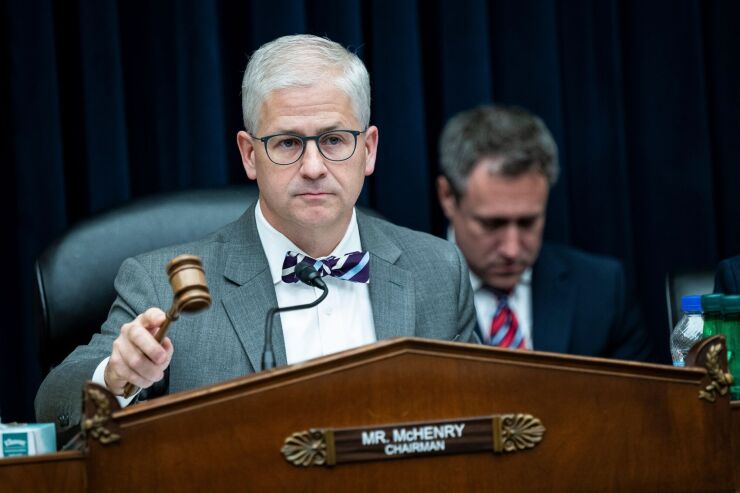
    “Broad and materials adjustments to the Basel III endgame necessitate a full re-proposal. Full cease,” stated Rep. Patrick McHenry, R-N.C., who chairs the Financial Services Committee. “Failure to take action will lead to an instantaneous Congressional Review Act vote out of this House of Representatives as rapidly as we will probably course of it.”

    When pressed for his views on the present stage of capital inside the banking system, Powell informed the committee it was “about proper,” however famous that figuring out the optimum quantity of capital isn’t a precise science. He stated his most important objective in finalizing the capital reforms is to place the U.S. on even footing with different giant international locations and banking jurisdictions world wide. 

    Powell added the adverse public response to the preliminary Basel III endgame proposal — accounting for properly over 90% of the general suggestions, by some estimations — is one thing that ought to be addressed. 

    “Broad assist, empirically, would imply an excellent strong vote on the Fed board. I’ve tried to not be particular about what which means,” he stated. “But it additionally means broad assist among the many broader neighborhood of commenters on all sides.”

    He additionally made clear that the Fed doesn’t intend to pursue some other regulatory reform gadgets — corresponding to new long-term debt necessities and liquidity requirements — till adjustments to the capital proposal are agreed upon and put forth to the general public.

    Powell stated the Fed is committing sources to bettering the infrastructure underlying its last-resort lending facility, the low cost window, including that the present person interface is “drained.”

    Another matter of repeated curiosity from legislators — each within the House Financial Services Committee on Wednesday and within the Senate Banking Committee on Tuesday — was govt compensation at banks. Specifically, lawmakers needed to know why the Fed didn’t be part of the FDIC, OCC and Federal Housing Finance Agency in proposing new restrictions on incentive-based compensation for financial institution leaders in May. The National Credit Union Administration and the Securities and Exchange Commission have pledged to take comparable steps within the close to future.

    Section 956 of the Dodd-Frank Act of 2010 required the monetary regulators to develop insurance policies on compensation to make sure executives weren’t incentivized to take extreme dangers. The proven fact that the Fed has gone so lengthy with out assembly this mandate has annoyed some members of Congress for years, however the situation has taken on renewed relevance within the wake of the failure of Silicon Valley Bank and different giant regional banks final yr. 

    Powell, who previously has stated he want to higher perceive the problem the regulators are searching for to unravel, testified that the Fed is continuous to discover the subject. At a number of factors this week, he pointed to steering the Fed issued concerning govt compensation in 2010 and famous that the company’s examiners strictly supervise banks to make sure they adhere to those requirements. He stated the Fed’s job isn’t completed, however implied on Wednesday that it might have met its authorized obligations.

    “Section [956] requires a rule or steering, by the best way,” Powell stated after an alternate with Rep. Nydia Velazquez, D-N.Y. “It doesn’t require a rule.”

  • Fed’s Powell says new proposal for Basel III endgame is “important”

    Jerome Powell Jerome Powell, chairman of the Federal Reserve, stated the Fed board of governors favors issuing a new capital reform proposal over finalizing a modified model of the bundle put forth final 12 months.

    Tierney L. Cross/Bloomberg

    Federal Reserve Chair Jerome Powell favors issuing a new capital proposal in response to the broad issues raised in regards to the reform bundle put forth by financial institution regulators final 12 months. But it is unclear if different Washington regulators really feel the identical.

    During testimony in entrance of the Senate Banking Committee on Tuesday, Powell stated the Fed has made important progress in absorbing the varied feedback it acquired in regards to the so-called Basel III endgame proposal and is “shut” to agreeing with the Federal Deposit Insurance Corp. and the Office of the Comptroller of the Currency on a path ahead. 

    Powell declined to debate particular modifications to the proposal, however stated an extra spherical of public commentary is “important,” given the diploma of modification.

    “My view, the strongly held view of the board, is that we do must put a revised proposal out for remark for some interval, and the explanation is when there are broad and materials modifications, that has been our observe,” he stated. “We do not see a purpose to deviate from that observe, it appears to be in keeping with previous observe and with the Administrative Procedure Act, in order that’s very a lot what we predict.”

    Powell stated Fed Vice Chair for Supervision Michael Barr, the central financial institution’s high regulatory official, is engaged together with his counterparts on the FDIC and the OCC, however the three businesses have but to make any remaining choices.

    The OCC declined to touch upon Powell’s remarks and the FDIC didn’t instantly reply to a request for remark.

    FDIC board member Jonathan McKernan — a Republican and frequent dissenter to the company’s regulatory insurance policies — expressed assist for opening the amended proposal to a different spherical of public commentary.

    “Count me in settlement with the strongly held view of others that we have to repropose the Endgame proposal with broad and materials modifications,” McKernan posted on X, the social community previously often known as Twitter, on Tuesday afternoon. 

    Powell stated he want to see the amended capital proposal issued for public remark alongside the findings of the Fed’s quantitative affect evaluation of how the most important 30 or so banks within the nation could be impacted by the new capital framework. He famous that the new proposal would seemingly include a remark window of 60 days or so, considerably shorter than the 120-day interval for the preliminary proposal.

    Powell stated there is “fairly a bit of labor” to be executed earlier than a revised proposal will be issued. He added that it additionally takes a number of months for feedback to be absorbed and included into the ultimate rule. He famous that the ultimate rule seemingly wouldn’t come collectively earlier than the top of 2024. 

    “It’s onerous to be exact,” Powell stated. “You write these things up, then you definately put it out for feedback, then you definately learn the feedback, then you definately write the ultimate rule. The starting a part of subsequent 12 months is a superb guesstimate.”

    Powell declined to say whether or not he thought the modifications being thought-about would represent a “logical outgrowth” from the unique proposal. If they had been, regulators may legally transfer to finalize the rule instantly, whereas in the event that they weren’t, a new discover and remark course of could be required below the Administrative Procedure Act.

    Proponents of the capital reform have argued that the broad set of questions requested by regulators once they issued the proposal final summer time offers them ample room to switch the rule and transfer straight to finalization. 

    Supporters of the proposal took situation with Powell’s feedback. Jeremy Kress, a legislation professor on the University of Michigan and a former Fed lawyer, stated the Fed chair is successfully “exercising a unilateral veto” on a direct finalization. 

    In a publish on X, Kress additionally stated it was a breach of etiquette for one financial institution regulator to overtly focus on divergent coverage views of different businesses.

    “Setting apart Powell’s private views on Endgame, it is uncommon for a Fed official to reveal an interagency rift to Congress with out the opposite businesses there to make their case,” Kress wrote.

    Opponents of the Basel III endgame, in the meantime, will likely be scrutinizing the subsequent proposal fastidiously. Trade teams representing the big banks have already signaled their readiness to sue regulators over the capital rule if it is not modified considerably, even going as far as to retain one of many high administrative attorneys within the nation to deal with the case. 

    Following the listening to, Greg Baer, president and CEO of the Bank Policy Institute, stated Powell’s feedback had been encouraging, however he famous that the banking commerce teams usually are not prepared to face down simply but. 

    “We are heartened that the proposal has been rethought and that the general public can have an opportunity to touch upon the rethinking; nonetheless, the main points listed below are essential, so clearly we might want to see the scope and particulars,” Baer stated in a written assertion. “And after all there stays the query of how the Basel proposal suits with the Federal Reserve’s stress check, the GSIB surcharge and different regulatory necessities.”

  • Senate Banking Committee sets day for FDIC nomination listening to

    Sherrod Brown Jon Tester Senator Jon Tester, D-Mont., talks to Senate Banking Committee chair Sherrod Brown, D-Ohio, in 2022. The Senate Banking Committee has scheduled a affirmation listening to for Christy Goldsmith Romero — now serving as a member of the Commodity Futures Buying and promoting Commission — to chair the Federal Deposit Insurance Corp., however her best affirmation will rely on unified assist from common Democrats like Tester and progressive varieties like Brown.
    Bloomberg News


    WASHINGTON — The Senate Banking Committee will take into account the nomination of Christy Goldsmith Romero to chair the Federal Deposit Insurance protection Corp. on July 11, the panel declared. 

    Goldsmith Romero, who in the mean time sits on the board of the Commodity Futures Trading Commission, was simply currently launched because the Biden administration’s resolve on to direct the FDIC within the wake of a workplace misbehavior scandal on the company. 

    The committee, within the actual listening to, can even take into consideration the nominations of Caroline Crenshaw to be a member of the Securities and Trade Fee, Kristin Johnson to be assistant secretary of financial establishments on the Treasury Division and Gordon Ito to be a member of the Money Steadiness Oversight Council with skills in protection. 

    The Senate Banking Committee listening to marks the primary formal transfer within the course of to confirming Goldsmith Romero’s nomination — a race in opposition to the clock at this level with a restricted variety of legislative days left in Congress. Goldsmith Romero would swap present-day FDIC Chairman Martin Gruenberg, who launched he would resign on the affirmation of a successor. 

    Should the nominations cross the Senate Banking Committee, they are going to go to the whole Senate.


    Though Goldsmith Romero hasn’t activated any pushback a lot from Republicans, the affirmation of her nomination is proceed to significantly from confirmed. 

    Democrats have sufficient votes to usher her and the opposite nominations on account of the Senate, however provided that they proceed being united of their assist — together with amid these trying for reelection in prone seats within the 2024 elections. Republicans have been unusually efficient in sinking the nominations of the Biden administration’s cash regulatory nominees within the earlier, pulling Democratic assist, for illustration, from picks like Sarah Bloom Raskin and Saule Omarova. 

    Really ought to she make it by the use of the affirmation process, Goldsmith Romero would inherit an FDIC that not solely is nonetheless reeling from the neighborhood revelation concerning the company’s tradition, however that has a busy regulatory schedule. 

    On Thursday — in what might very very properly be Gruenberg’s ultimate board assembly as chairman —  the corporate finalized a rule bolstering decision choices for huge regional banking firms. Other crucial rulemakings, just like the Basel III endgame proposal, are nonetheless pending. 

    Goldsmith Romero maybe would have solely a restricted vary of months with a Democratic board. Need to Donald Trump purchase the presidential election, Goldsmith Romero wouldn’t essentially have to motion down as chairman, however could be up versus a 3-2 partisan break up that might make governing the company sophisticated.

  • McHenry needs Gruenberg testify on FDIC toxic society

    Patrick McHenry Rep. Patrick McHenry, R-N.C., who chairs the Property Economical Providers Committee, has requested Federal Deposit Insurance plan Corp. Chair Martin Gruenberg to testify on June 12 pertaining to allegations of prevalent situations of sexual harassment and discrimination on the firm spanning a very long time.

    Bloomberg Information

    WASHINGTON — Rep. Patrick McHenry, R-N.C., chairman of the Home Fiscal Products and providers Committee, has set a date for a listening to that particularly examines the Federal Deposit Insurance coverage Corp.’s workplace society on June 12. 

    FDIC Chairman Martin Gruenberg has now testified in entrance of the House Economic Providers Committee as a part of a beforehand scheduled oversight of the prudential banking regulators. It was his preliminary time taking considerations provided that the launch of a report from the regulation enterprise Cleary Gottlieb that outlined a pervasively toxic society on the firm. 

    Whilst that report didn’t come throughout that Gruenberg was a most necessary instigator of the worst challenges within the report, it did elevate inquiries about his temperament and his means to information the company by way of its following stage. 

    McHenry, within the letter, demanded that Gruenberg testify on the subsequent of two panels on June 12, to totally grasp how Gruenberg “will deal with the FDIC’s workplace society as chairman.”

    Gruenberg acknowledged he would resign from the corporate, at which he has served for round two a very long time, like practically a decade as chairman, as quickly because the Biden administration has a brand new chairman confirmed by the Senate. Given the minimal vary of legislative days nonetheless left previous to the 2024 elections in November, Gruenberg might carry on to information the company for months to happen. 

    “Your look is necessary in order that Congress can guarantee its banking firms are performing to maintain safety and normal public self esteem within the nation’s financial course of,” McHenry talked about. 

    McHenry instructed performing Comptroller of the Forex Michael Hsu, who beforehand defended Gruenberg’s means to hold on atop the FDIC, and FDIC board member Jonathan McKernan that they’d testify on the to begin with panel earlier than within the working day. McKernan and Hsu are co-chairs of the unique evaluation committee that is overseeing the reforms advisable by the Cleary Gottlieb report. 

    A agent from Cleary Gottlieb may even be on that 1st panel, McHenry talked about within the letters to Gruenberg, McKernan and Hsu. 

  • RESPA, HMDA violation fines hit Arkansas’ Financial institution of England

    Financial institution of England in Arkansas and 9 former employees have settled with a regulator greater than their violations of a number of actual property guidelines impacting over 900 people.

    The Federal Deposit Insurance coverage Corp. requested the lender to pay a $1.5 million civil money penalty, and its ex-workers to pay a blended $263,500, it launched Friday. Among the so much of infractions, originators in a single explicit place of work misled Department of Veterans Affairs refinance mortgage candidates to really feel they might skip two months of house mortgage funds. 

    “Veterans and their households who had been deceived into refinancing their VA loans had been overcharged and didn’t obtain the mortgage merchandise promised, leading to substantial purchaser harm,” said Mark Pearce, the FDIC’s division of depositor and buyer protection director, in a press launch. 

    The mortgage firm additionally lured debtors with small mortgage charges that had been lifted previous to closing, in accordance to the FDIC. The lender has produced $1.9 million in remediation funds to above 900 individuals. 

    A agent for the Financial institution of England didn’t reply to a ask for for comment Monday. 

    The sizable retail lender headquartered southeast of Minimal Rock presents widespread, governing administration-sponsored, jumbo and family fairness monetary loans. It claimed 324 registered home mortgage monetary mortgage originators on the conclusion of 2023, in accordance to buyer Nationwide Multistate Licensing Procedure info, and lists 13 branches.

    The Lender of England violated the Real Estate Settlement Strategies Act by coming into paid out co-marketing preparations and desk rental agreements with true property brokers, the regulator claimed. It additionally had RESPA violations with brokers in an undisclosed vary of reverse mortgage mortgage transactions. 

    In addition, the depository additionally failed to offer shoppers with group delivers of credit score historical past in violation of the Honest Credit Reporting Act, and did not report appropriate details on its 2021 mortgage utility in violation of the Residence Mortgage mortgage Disclosure Act. 

    Workers like former division and income directors had been being hit with totally different fines, with two department supervisors paying out $110,000 and $100,000 civil {dollars} penalties, respectively. 

    The lender additionally agreed to a consent get ultimate August with the FDIC, during which it ought to put into motion compliance controls, coaching pointers and audit techniques and put up quarterly experiences to the FDIC. 

    Regulators have stored a watchful eye on lenders this 12 months, because the Office of Housing and Urban Enhancement not too way back penalized over 70 institutions for Federal Housing Administration infractions. The Consumer Economic Security Bureau additionally repeatedly declares enforcement actions and really final month scrutinized servicing costs. 

  • Financial institutions remaining in limbo as regulators mull route forward for Basel

    Barr Gruenberg Federal Reserve Vice Chair for Supervision Michael Barr and Federal Deposit Coverage Corp. Chair Martin Gruenberg are high the drive for massive financial institution money reform, together with performing Comptroller of the Forex Michael Hsu.

    Anna Rose Layden/Bloomberg

    Washington’s controversial cash proposal is on preserve indefinitely as regulators work out a possible route forward for the reform provide. In the meantime, the banking sector continues to be left in limbo. 

    Improvements are coming to the so-named Basel III endgame — which might improve cumulative funds calls for for substantial monetary institutions by 16%  — however irrespective of if regulators modify the current proposal or unveil a wholly new supplying continues to be to be discovered. 

    Based on the tack taken by the Federal Reserve, the Federal Deposit Insurance protection Corp. and the Place of labor of the Comptroller of the Currency, adopting new funds guidelines may get anywhere from a pair months to completely above a 12 months. And their distinct alterations may final result in an unlimited number of outcomes. 

    For banking firms keen on altering their small enterprise merchandise and concord sheets to satisfy regulatory necessities as quickly as potential, this uncertainty suggests possessing to prepare for all choices.

    “Our institutions do not know what the trail forward is, so they’re prone to run on the idea of remaining ready for whichever outcomes may occur,” defined Kevin Fromer, president and CEO of the Money Products and companies Forum, a commerce staff for the eight largest banking firms in the nation. “Buyers count on our associates to fulfill regulatory proposals lengthy previous to they’re utilized, and so they as a outcome should be able to deal with their cash in keeping with the best info that they’ve.”

    Francisco Covas, authorities vice chairman and head of examine on the banking commerce group Lender Coverage Institute, talked about the group began advising its clients to retain earnings and purchase different preemptive methods when the proposal was issued final summer season.

    The consensus try is that the final mannequin of the rule — having stated that it’s attained — will embody decreased capital wants than in the unique put together. But, Covas acknowledged the uncertainty suggests banking firms should be conservative till they know the way and when these modifications are potential to contemplate outcome.

    “Until this will get mounted in circumstances of the timing, companies will probably be cautious on how they’re prone to deploy funds and think about benefit of prospects that crop up,” he acknowledged. “We are eager to know far more particulars and particularly wherever factors will inevitably land.”

    Fed Chair Jerome Powell promised “vast and supplies” changes throughout congressional testimony in March. He additional that he can be open to issuing a brand new proposal, if the diploma of alter warranted this form of a go.

    Previous 7 days, Powell claimed the central lender stays absolutely commited to using the worldwide benchmarks agreed upon by the Basel Committee on Banking Supervision in 2017. He additional that the proposal is the company’s main regulatory precedence, however stated the Fed’s board of governors has not settled on a program of motion.

    “We have not constructed any alternatives on coverage or on methodology in any respect, nothing — no alternatives have been created,” Powell talked about all by way of his put up-Federal Open Current market Committee push assembly. “I’ll say but once more, although, if we conclude that reproposal is good, we might not wait to insist on that.”

    The FDIC and OCC declined to touch upon the rulemaking course of this 7 days. 

    Company rulemakings are dominated by the Administrative Method Act, which calls for coverage alterations to be put as a results of a so-known as discover and remark process for the general public to weigh in on the proposal and voice worries. Businesses ought to then take in this commentary, reply to it and, the place by acceptable, use it to amend the closing mannequin of a rule. 

    Changes manufactured to remaining guidelines should be a “rational outgrowth” of what was in the genuine proposed rule. Several in and throughout the banking sector argue that the enhancements needed for the Basel III endgame proposal exceed this regular, and therefore a wholly new rule ought to actually be set by the use of its have detect and remark interval. 

    “The rule want to enhance significantly supplied the fears elevated by a broad spectrum of industries and firms, the envisioned have an effect on on the financial local weather, the complexity of the rule, as properly as the impacts it has on different sections of the cash framework and regulation,” Fromer defined. “With most of these substantial enhancements anticipated, the enterprise and different intrigued events ought to actually be outfitted to know all these enhancements and touch upon them to make completely positive there aren’t unintended repercussions. That can be a smart means forward for a rule that has elevated extremely substantive points and many system points as successfully.”

    Other people say the regulators have an enormous berth for creating enhancements beneath the cheap outgrowth doctrine. 

    Jeremy Kress, a regulation professor on the College of Michigan and a former Fed legislation agency, reported companies are offered vast deference on what’s a rational outgrowth. He additional that the way in which regulators approached the Basel III endgame — by which embody 174 particular queries and alternate options for some provisions — gave them sufficient latitude to make enhancements with out the necessity of attending to repropose.

    “As lengthy as they’re in the realm of chance-centered cash working with credit score historical past danger, operational hazard and sector hazard, the companies have opened these frameworks for most of these broad remark and have obtained this sort of vast comment and on all components of people difficulties, that they’ve a really substantial amount of leeway in going straight to a remaining rule,” Kress reported.

    The Fed, FDIC and OCC obtained much more than 400 letters concerning the Basel III endgame for the period of an prolonged remark time interval of virtually six months. Even in the course of typical rulemakings, the consider method usually takes fairly a number of months. But not solely has the Basel III endgame proposal acquired additional opinions than traditional, the commentary can also be decidedly simply one-sided, with 97% of responses turning into antagonistic, in keeping with evaluation by the regulation group Latham & Watkins.

    Shayna Olesiuk, director of banking protection for the customer advocacy group Superior Marketplaces, talked about the intensive opposition has contributed to a story in and throughout the banking sector that reproposal is required. In actuality, she acknowledged, a whole lot of of the problems might be addressed by creating minor changes to the proposal.

    “In quite a few methods, the quantity of opposition to the proposal does expertise like new territory,” Olesiuk claimed. “But regardless of this, we should always actually not and are unable to remove emphasis on the a number of essential advantages of the rulemaking for the American women and men, like economical safety and elevated lending by way of the ups and downs of the financial cycle.”

    Improvement of the Basel III endgame — be it finalization or reproposal — appears to hinge on the Fed governors arriving at what Powell has described as a “consensus” perspective on easy methods to go forward. This in all probability suggests the up coming version of the proposal should safe assist from Powell and Fed Vice Chair Philip Jefferson, each of whom voted in favor of the unique model final July however with main reservations. Two different board associates, Govs. Michelle Bowman and Christopher Waller, voted versus the proposal and proceed to be against it.

    At the time of the proposal, Powell noticed many areas that he want to see suggestions on, just like the proposal’s results on money markets and operational danger administration. He additionally flagged the truth that the proposal exceeds the conventional set by the Basel Committee and equal reforms at the moment being considered by regulatory businesses throughout the setting — some extent he reiterated final 7 days, noting that the rule should be “reliable to Basel and likewise equal to what the opposite substantial comparable jurisdictions are finishing up.”

    Jefferson has shared variety of opinions on the proposal because of the reality it was launched ultimate summer season season. But, on the time, he expressed drawback concerning the framework’s impression on the banking sector and the broader monetary state. 

    Olesiuk, a earlier deputy director for deposit protection and hazard analysis on the FDIC, reported there are quite a few methods for regulators to tweak the proposal with out having touching its most important elements.

    “Generating adjustments on the credit score facet can be an inexpensive trade-off to take care of issues like operational and market place menace, that are significantly additional important in magnitude and materially bolster the funds framework,” she defined.

    Some say the operational changes — exactly the shift away from banking institutions staying ready to make use of inner designs to standardized varieties for calculating capital wants — are essentially the most onerous in the proposal and should be altered. 

    Other analysts have identified that changes may very well be designed to cut back the whole funds load of the reform. These might encompass amending the surcharge proposal for worldwide systemically important banking firms, or GSIBs, that was put out together with the Basel III reform or dropping the fear funds buffer prerequisite from the lately expanded danger-dependent technique.

    Regardless of what trade-offs are made internally inside the businesses, the final model of the rule — irrespective of if it comes in a while this calendar yr or additional down the road — will probably be vastly scrutinized by the banking enterprise, which has expressed a bigger willingness to sue its regulators in new years.

    “I hope and expect that the banking businesses need to get this carried out and need to get it executed in a means which goes to defend it from market points,” Kress reported.

  • New facts on hurry of House Personal loan bank borrowings at a few unsuccessful banking companies

    Silicon Valley Bank - First Republic Bank - Signature Bank

    The Government Accountability Business workplace positioned that Silicon Valley, Signature and First Republic banking establishments on the eve of their failures borrowed considerably extra from the House Personal loan Lender System than a workforce of their friends that built-in 16 skilled banking companies.

    Silicon Valley Bank, Signature Bank and Initially Republic Bank larger their excellent borrowings from the Federal Dwelling Financial loan Lender Process by excess of a third each single shortly forward of failing, based on the Governing administration Accountability Business workplace.

    The enhance in borrowings is the subject of a 27-webpage GAO report issued final week that examines the operate of the Federal House Personal loan monetary establishments in furnishing liquidity to their associates via the banking catastrophe within the spring of 2023. The report offers a granular purchase on the place {dollars} was going to the unsuccessful monetary establishments within the ninth inning of their existence as every sought to stem enormous outflows from depositors. 

    The GAO uncovered that the three banking establishments borrowed considerably extra from the Home Loan Financial establishment Process than a group of their friends that supplied 16 industrial banking companies.

    The report is the to begin with in a assortment by which the GAO will look at broader challenges linked to the Dwelling Loan Bank System. The private neighborhood of 11 regional, cooperative banks was produced in 1932 instantly after the Wonderful Melancholy to function a provide of funding for thrifts originating house loans. The report was requested by Household Economic Companies Committee Chairman Patrick McHenry, R-N.C., and the panel’s rating Democrat, Rep. Maxine Waters of California.

    “GAO uncovered the FHLBs of New York and San Francisco supplied main ranges of developments to those banks in comparison with different individuals, and that Signature Financial establishment made use of FHLB improvements to offset liquidity gaps it skilled linked to crypto-relevant deposits,” Waters acknowledged last 7 days in a press launch. “Meanwhile, SVB was not in a position to reposition collateral promptly sufficient from its FHLB to the Fed’s discounted window to entry disaster liquidity.”

    Starting up on March 1, 2023, SVB improved its borrowings by 50% to $30 billion after which failed a 7 days afterwards. Signature’s borrowings rose 37% to $11.2 billion within the to begin with two weeks of March previous to it failed that similar month. And Initially Republic’s borrowings jumped 45% to $28.1 billion within the preliminary two weeks of March previous to it unsuccessful in May, the GAO report found. 

    The GAO regarded at the communication and coordination of the Home Financial loan monetary establishments with the Federal Deposit Insurance Corp. and Federal Reserve System — the unsuccessful banks’ main federal regulators — and the compensation of the failed banks’ distinctive monetary loans, recognised as advances, to the system. 

    “A single of crucial spots of focus is: Are the Federal Property Bank loan banking establishments dealing with their associations and their counterparty hazard with establishments as they begin off to are unsuccessful, and have they got the precise agreements and oversight in place with the Fed and others?” reported Jim Parrott, co-operator of Parrott Ryan Advisors and a nonresident fellow at the Urban Institute. “When every little thing’s possible 90 miles an hour, as an institution commences to only take on water, are all of the relevant regulators and different people who’re in some feeling not directly accountable for taxpayer challenges … coordinating?”

    The GAO reported that SVB failed previous to the Federal Home Personal loan Financial establishment of San Francisco was succesful to request extra supervisory particulars from the Federal Reserve Lender of San Francisco. The New York and San Francisco Household Mortgage banking companies the 2 have been geared up to attach with the FDIC about Signature and Very first Republic as these banking establishments had been declining, the GAO reported.

    “It was placing to me that [the Home Loan banks] stored lending to those failing banking establishments till the fairly previous 7 days or instances forward of they failed,” mentioned Sharon Cornelissen, director of housing at the Shopper Federation of The us and chair of the Coalition for FHLB Reform. “Only because the Federal Dwelling Bank loan Financial establishment of San Francisco doesn’t lend across the weekend, SVB was frantically in search of to achieve entry to the [Fed’s] worth discount window at the gorgeous earlier second.”

    The report was produced fairly a few months instantly after the Federal Housing Finance Agency’s analysis of the method. FHFA, the system’s regulator, produced a 100-year evaluate of the House Financial loan banking establishments in November that included 50 suggestions for reforms. Waters mentioned she is doing work on legal guidelines to use a lot of of the FHFA’s suggestions, together with doubling the system’s contributions to cost-effective housing to twenty% from the most recent congressionally-mandated 10%. She is also discovering methods to extend entry and working of the Fed’s low value window. 

    Teresa Bazemore, president and CEO of the San Francisco Dwelling Financial loan Lender, mentioned in an job interview final week that it’s important to have an understanding of what was occurring upfront of the March 2023 liquidity catastrophe. Banking companies and credit score rating unions have been flush with document levels of deposits in 2021 from governing administration stimulus packages in response to the pandemic. At that point, the Residence Mortgage banks’ core small enterprise of supplying liquidity to members skilled dried up. But in 2022, income trade mutual money commenced offering depositors increased expenses, inserting heaps of banking establishments in a squeeze.  

    “Some of the revenue began to outflow from [member] banking establishments at the similar time people establishments had by now invested some of that money. They’d now loaned it out, they’d presently created house finance loan loans [and] put them of their portfolios. They purchased securities,” Bazemore mentioned. “So when you look at wherever objects had been at the conclusion of 2021 to the shut of 2022, you noticed our developments go up as a method just because of that switch of deposits out of the banking establishments and credit standing unions. And that’s genuinely what the method was established up for.”

    The Federal Reserve hiked need charges 11 events involving 2022 and 2023 in an attempt to management inflation. As a outcome, f
    airly a few banking establishments ended up “the other way up” and desired to borrow from the Dwelling Personal loan Financial establishment System, or alternatively, needed to carry in brokered deposits, Bazemore talked about. Brokered deposits are usually designed by corporations with the assistance of a third bash.

    “If you have got acquired a portfolio of 3% mortgage loan monetary loans, the place by are you heading to get the money circulate to spend 4% or 5%, to compete with the money market [funds]?” Bazemore requested.

    The GAO report additionally appeared at the reimbursement of improvements by the failed banks and whether or not or not there was a worth to the federal Deposit Insurance plan Fund. Right after regulators took intense strategies last calendar yr to protect uninsured depositors, notably enterprise capitalists quickly after the failure of SVB, the FDIC assessed a distinctive price on extra than 100 banks to replenish the fund, acknowledged in lender parlance because the “DIF.” 

    The GAO report talked about that reimbursement “doesn’t impose a quick value” however that “exploration conclusions fluctuate” in regards to the threats that unsuccessful banks’ improvements from this system pose to the DIF. Dwelling Mortgage banking establishments have a priority placement ahead of the FDIC when a lender goes into receivership, an issue that has transform a bone of competitors among the many critics of this system. 

    The GAO claimed that in 2000 and 2005, respectively, analysis by the Fed and FDIC famous that “FHLBanks’ precedence place in receivership may subsidize member bank danger-getting, which may point out greater losses for the Deposit Insurance coverage Fund.”

    The GAO additionally reported that a 2023 FHFA consider of tutorial literature recognized that House Loan banks’ regulatory pointers and practices mitigate moral-hazard issues, while a analysis by the City Institute previous calendar yr recognized that an improve in a industrial bank’s use of improvements lowers the percentages of failure, considerably for a scaled-down bank.

    However, the report identified that “if proceeds of the failed bank’s liquidated property don’t defend guarantees eligible for the fund instantly after compensation of FHLBank advances and some other secured statements, the Deposit Insurance plan Fund would incur bills.”

    The GAO report additionally detailed the bills billed by each of these the San Francisco and New York Property Mortgage banking establishments, which numerous significantly. 

    Bank failures might presumably trigger prepayment service charges that the Dwelling Loan monetary establishments value, that are crucial by the FHFA for explicit options. Waiver prices additionally might maybe be billed if a member-financial establishment will make voluntary prepayments. The Home Bank loan banking establishments additionally might waive the costs, and even cost the FDIC, because the receiver of a unsuccessful lender, a waiver fee to compensate for pitfalls. 

    Prepayment penalties additionally fluctuate dependent on the size and phrases of an advance. The FDIC ordinarily pays off enhancements and incurs a price in get to only take the collateral that has been pledged by a industrial monetary establishment to a Household Bank loan bank. 

    After SVB failed, the FDIC transferred all its deposits and roughly all of its property to Silicon Valley Bridge Financial establishment, which repaid the $30 billion in excellent developments to the San Francisco Dwelling Bank loan Lender. The San Francisco bank acquired $266.5 million in prepayment bills and $18.8 million in waiver service charges. Most of SVB’s developments skilled phrases of a particular person to 3 a few years. 

    “SVB didn’t have a sure talked about tactic for borrowing developments in that maturity fluctuate,” the GAO talked about, citing officers from the San Francisco Property Mortgage Financial establishment. 

    Meanwhile Very first Republic’s wonderful developments have been assumed by JPMorgan Chase, which repaid roughly $5.8 billion in monetary loans that had attained maturity, and has indicated that it plans to repay the remaining developments based on the progress circumstances. 

    In distinction, after Signature Financial establishment unsuccessful, the Federal Property Financial loan Bank of New York additionally been given complete compensation for Signature’s $11.2 billion in unbelievable developments however acquired simply $260,000 in prepayment prices and no waiver expenses.  

    “The broader dialogue is irrespective of whether or not that is the half that we would like [the FHLBs] to carry out,” Cornelissen claimed. “According to the regulation they ended up inside simply their rights to provide liquidity, however we should always actually be a lot extra tightly regulating them primarily as a result of it actually shouldn’t be their put to be the loan supplier of earlier resort. They are going to protect lending till finally the gorgeous earlier working day primarily as a result of that’s their firm design and provides no hazard to them.”

    Ryan Donovan, president and CEO of the Council of Federal Home Bank loan Financial establishments, the system’s commerce group, applauded the GAO report for locating that the method designed makes an attempt to coordinate with the Federal Reserve monetary establishments of New York and San Francisco in accordance with insurance coverage insurance policies and processes.

    “We benefit from the conclusions within the GAO’s report, and we predict they validate what we have now been indicating for a yr: that the FHLBanks acted as a essential shock absorber for the fiscal system all through a time interval of unparalleled turbulence within the spring of 2023,” Donovan talked about. “The two most important takeaways from this report are that the FHLBanks provided essential liquidity to their members in direct accordance with the framework and performance laid out for them by Congress, and that the FHLBanks labored tirelessly in a coordinated vogue with main monetary regulators to make sure the security and soundness of the U.S. banking process.”

    The Federal Home Personal loan Bank Technique famous earnings of $6.7 billion at yr-stop, an 111% soar from a yr earlier than. The course of additionally paid out a historical past $3.4 billion in dividends to its associates, extra than double the $1.4 billion compensated in 2022.

    The GAO report is dated March 8 however was unveiled on April 8 following lawmakers and the Residence Mortgage banking companies had a month to guage its conclusions.