Tag: courtroom

  • Supreme Courtroom ends Chevron deference in landmark final decision

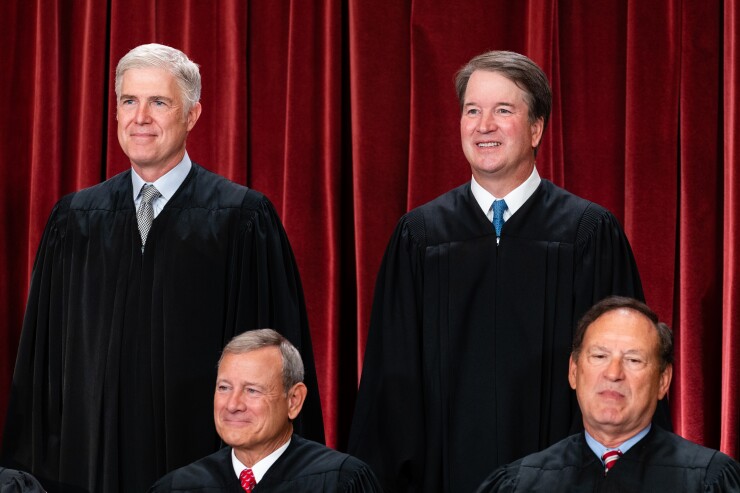
    john Roberts, Samuel Alito, Neil Gorsuch, Brett Kavanaugh The feeling overturning Chevron deference was created by Main Justice John Roberts (base left) and joined by Justices Samuel Alito (backside acceptable), Neil Gorsuch (main correct) and Brett Kavanaugh (prime rated correct), in addition to Justices Clarence Thomas and Amy Coney Barrett (not pictured).

    Eric Lee/Bloomberg

    The Supreme Court on Friday overturned a big authorized precedent requiring judges to defer to federal regulatory companies’ interpretation of ambiguous statutes. The 6-3 ruling reduces the power of a in depth collection of authorities division companies, which embody lender regulators, to interpret guidelines.

    The 40-calendar year-aged lawful doctrine — recognised as Chevron deference, named for the 1984 Supreme Courtroom choice in Natural Means Protection Council v. Chevron organising the precedent — had extended aggravated corporations in managed industries as a result of it constrained their means to sue companies above their interpretations of vast or obscure authorized authorities. 

    The doctrine incessantly meant that regulators might create broader, way more expensive pointers than managed corporations thought-about have been warranted. Its demise is anticipated to open up the floodgates to a wave of litigation demanding such ideas.

    But the shut of Chevron deference may very well be a double-edged sword for banking establishments, in response to sector authorized professionals, given that the Supreme Court’s conclusion will even make it easier for advocacy teams and state attorneys typical to problem guidelines they oppose, which might introduce further uncertainty for banking corporations.

    The ruling by the massive court docket’s conservative higher half, printed by Main Justice John Roberts, held that the Administrative Course of motion Act requires courts to work out their unbiased judgment in figuring out irrespective of if an company has acted within its statutory authority. Courts have the choice to defer to an company’s interpretation of an ambiguous regulation, however the court docket stated the agency prerequisite that it must is wrong.

    “The deference that Chevron requires of courts inspecting firm movement can’t be squared with the APA,” Roberts wrote. “Potentially most primarily, Chevron’s presumption is misguided since companies don’t have any particular competence in resolving statutory ambiguities. Courts do.

    “Chevron has proved to be mainly misguided,” he ongoing. “And its flaws had been apparent from the get began, prompting the Courtroom to revise its foundations and consistently restrict its software program. Experience has additionally confirmed that Chevron is unworkable.”

    The court docket’s dedication encompassed two situations: Loper Dazzling Enterprises v. Raimondo and Relentless v. Section of Commerce. The conditions included fishermen in New Jersey and  Rhode Island who claimed the Countrywide Marine Fisheries Provider couldn’t impose a price necessitating federal observers on herring boats, centered on the relevant regulation.

    In a dissenting impression, Justice Elena Kagan wrote that for 40 a long time, Chevron deference has served “as a cornerstone of administrative laws, allocating accountability for statutory design in between courts and firms.”

    “This Court docket has in depth acknowledged Chevron deference to mirror what Congress would need, and so to be rooted in a presumption of legislative intent,” wrote Kagan, who was joined by Justice Sonia Sotomayor. “Congress is aware of that it doesn’t — in truth cannot — publish fantastically whole regulatory statutes.”

    Justice Ketanji Brown Jackson joined the dissent in one explicit of the 2 conditions however was recused from the opposite as a result of she took part in it as a federal appeals courtroom select.

    Going ahead, federal companies might be lower than larger scrutiny, offering area actors much more prospects to impediment firm insurance policies and interpretations of the regulation, attorneys defined.

    “The selection may very well be considered as putting regulated communities on a much more equal footing with the companies,” said Varu Chilakamarri, a companion on the laws enterprise Okay&L Gates.

    The stakes present as much as be specifically excessive for the Customer Economic Defense Bureau. The CFPB has a standing as staying much more intense than another federal organizations, and thru the Biden administration, the bureau has situated its pointers routinely challenged in court docket docket.

    The CFPB said Friday that it’s inspecting the ruling and declined to comment.

    The CFPB’s interpretations of guidelines will now be subject to “heightened assault,” defined Joe Lynyak, a partner at Dorsey & Whitney.

    “Courts all around the area could also be inundated with personal get-togethers who might maybe now litigate and relitigate an firm interpretation, resembling creating conflicting decisions by decreased courts,” Lynyak talked about.

    Eamonn Moran, senior counsel at Norton Rose Fulbright, claimed the rollback of Chevron deference might effectively final consequence in the overturning of restrictions this sort of because the CFPB’s $8 bank card late payment rule. But he additionally cautioned about seemingly downsides for banking establishments.

    “Although there could be now further likelihood for the plaintiff’s authorized professionals to contemplate to undo laws on account of courtroom challenges, business would possibly now be confronted with lack of predictability and compliance troubles,” Moran talked about.

    Leah Dempsey, co-chair of the fiscal skilled providers observe on the laws group Brownstein Hyatt Farber Schreck, pointed to what she described as worries for regulated companies stemming from the court docket’s dedication, in addition to the possibilities.

    In an interview previous to the final decision was produced, Dempsey stated that corporations are usually looking out for readability on how one can function, and argued that the demise of Chevron might restrict the talent of companies to offer a lot of these readability.

    Kate Decide, a professor at Columbia Regulation School, wrote in a social media write-up that banks, like fairly a couple of corporations, “might probably see Chevron’s slide as a earn, however the Chevron doctrine was central in facilitating deregulation.”

    “The consequence now doesn’t suggest a lot much less regulation it simply makes sure way more uncertainty concerning the obligations the regulation imposes on managed entities,” Judge wrote on X, beforehand recognised as Twitter.

    Joann Needleman, an lawyer on the laws firm Clark Hill, well-known that a number of legal guidelines which have an have an effect on on the economical corporations sector are a long time earlier, so they won’t present clear steering about how organizations might use newer technological innovation. It has very lengthy been as much as regulators to fill in these gaps.

    Needleman defined that following the demise of Chevron deference, she will be able to foresee litigation by shopper advocates difficult pointers that the CFPB arrange as regards to using modern communications applied sciences by debt collectors. The CFPB’s 2020 rule implementing the Good Personal debt Assortment Procedures Act addresses using e-mail and textual content material messages by debt collectors.  Advocates have opposed sections of the regulation.

    Needleman, who’s a former president of the board of administrators of the Countrywide Collectors Bar Affiliation, claimed in an job interview proper earlier than the court docket’s choice was produced that the CFPB’s rule supplies a contemporary interpretation of a many years-previous regulation.

    “A substantial amount of what the CFPB did about that regulation was undoubtedly useful,” she said.
  • If Supreme Courtroom sides with CFPB, ‘flurry’ of litigation moves ahead

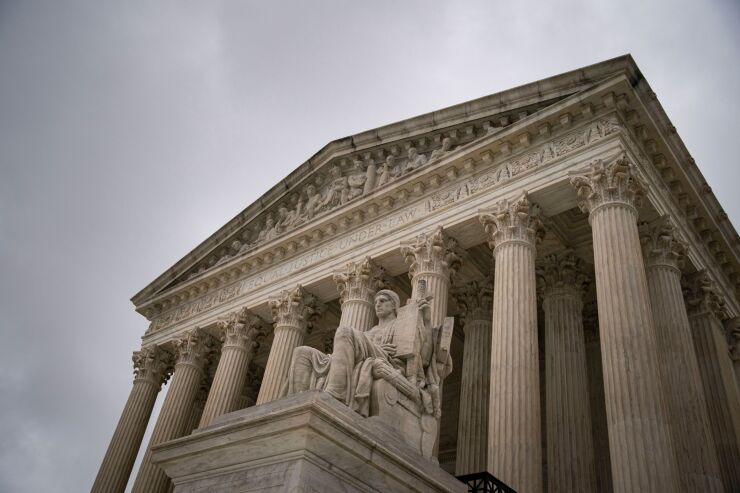
    Supreme Court Lots of licensed specialists really feel the Supreme Courtroom will rule in favor of the Customer Fiscal Safety Bureau in a case robust its funding. This type of a ruling would unleash a flurry of litigation that has been on keep pending the consequence of the constitutional impediment. 

    Bloomberg Creative

    The Supreme Court is predicted to rule by the conclusion of June on whether or not or not the funding framework for the Shopper Fiscal Safety Bureau is constitutional. If the courtroom sides with payday collectors that sued the CFPB proclaiming its funding is unconstitutional, there can be huge fallout for different organizations, collectively with the Federal Reserve, the Office of the Comptroller of the Forex and the Federal Deposit Insurance coverage Corp. 

    But fairly a number of lawful specialists suppose the big courtroom docket is extra very more likely to rule in favor of the CFPB based on oral arguments heard in October when solely only one justice — Affiliate Justice Sonia Sotomayor — questioned what remedy there should be if the company’s funding by the Federal Reserve Process is noticed to be unconstitutional. 

    Since the justices unsuccessful to dedicate considerably time to a remedy — and in its place had been remarkably skeptical that Congress improperly funded the bureau — a number of monetary firms sector attorneys are actually gaming out what’s going to materialize to many pointers and lawsuits which have been on maintain pending the outcome of the scenario, Buyer Money Protection Bureau v. Neighborhood Financial Services Association of The us.

    “I depend on the CFPB to win,” acknowledged Alan Kaplinsky, senior counsel at Ballard Spahr, who expects the ruling has taken so intensive to decide as a result of of to interrupt up selections by the justices. “There will likely be a number of viewpoints and dissenting ideas and presumably concurring ideas, and it takes time to get all that carried out.”  

    Quite a number of authorized professionals who submitted amicus briefs on behalf of CFSA, the lead commerce workforce for payday lenders that sued the CFPB in 2018, don’t think about the payday mortgage suppliers will acquire, Kaplinsky stated. The common see has been that Solicitor General Elizabeth Prologar, representing the CFPB, launched a stronger scenario than her counterpart, Noel J. Francisco, a former solicitor fundamental representing the payday groups, who struggled by oral arguments to affect a overwhelming majority of the justices that Congress skilled inappropriately delegated its authority to the CFPB. 

    “They did not request the bureau or each social gathering, how can we repair this? What is the choice?” reported AJ Dhaliwal, a companion on the regulation company Sheppard Mullin. “Since they didn’t get into that, they can’t blow [the CFPB] up.”

    Michael Benoit, chairman of the laws firm Hudson Prepare dinner LLP, acknowledged that if the Supreme Court sided with payday mortgage suppliers, the impression on federal financial regulators can be enormous. 

    “I’ve by no means ever felt the funding argument was extremely potent,” Benoit stated, incorporating that while the Supreme Court docket just isn’t meant to be political, “a remaining choice that invalidates decades-extensive funding mechanisms can be a political earthquake in an election calendar yr — primarily this election yr.”

    Quite a number of authorized specialists at first thought-about all of the CFPB’s earlier pointers and steps can be threatened when a three-choose panel of the U.S. Court docket of Appeals for the fifth Circuit vacated the payday lending rule in 2022 and located that the CFPB’s funding exterior the home the congressional appropriations system violates the Constitution’s separation of powers. Considering that then, difficulties to the CFPB’s funding have been half of just about every particular person lawful transient in litigation submitted in the direction of the company indirectly, kind or type, attorneys reported. 

    But provided that the oral arguments had been held in October, there was a reversal. Authorized specialists consider a flood of litigation will likely be unleashed following the Supreme Court guidelines within the CFPB’s favor. 

    “It will likely be a flurry of exercise,” Kaplinsky stated. 

    Past calendar yr the CFPB launched into a deciding on spree in only one of the most important recruitment drives on the firm in anticipation of litigation going ahead. 

    3 major pointers presently on preserve will go ahead, just like the payday lending rule, the smaller enterprise enterprise details assortment rule and a contentious anti-discrimination plan.

    “There is definitely a lull proper now earlier than the choice,” Dhaliwal defined. “The drop was extraordinarily occupied and contemplating the truth that the New Year, it’s gotten true quiet in side as a result of reality of the Supreme Courtroom choice that is more likely to arrive out.”

    In the meantime, 9 enforcement steps and 5 petitions to implement civil investigative requires have been stayed pending the result of the CFSA circumstance, in accordance to the CFPB.

    “The CFPB is searching ahead to the Court’s choice, and within the meantime, we’ve got continued to hold out the very important consumer security function that Congress has charged us to conduct,” a CFPB spokesperson claimed.

    Among the the insurance policies which are on maintain, the payday rule is the best living proof of how an firm rule will be locked in litigation for a number of years. 

    Initially formulated and finalized in 2017 by earlier CFPB Director Richard Cordray, the payday rule was stripped of a provision requiring that lenders set up a debtors’ means to repay a mortgage, and its preliminary 2018 compliance day was postponed by a Texas select proper after commerce groups sued the bureau. What continues to be, if the rule will get enacted quickly after the Supreme Court circumstance, is a restriction that bars payday lenders from incomes rather more than two unsuccessful makes an attempt to debit fee for a payday private mortgage from a shopper’s checking account. The limits have been made to defend debtors from having their assets garnished by mortgage suppliers and from incurring repeat overdraft charges.

    Meanwhile, the tiny-enterprise particulars assortment rule — generally known as 1071 for its section within the Dodd-Frank Act — would want that banking establishments, credit score rating unions and little-business enterprise mortgage firms acquire and report particulars on apps for credit score rating, largely to determine whether or not or not little-business monetary loans are being manufactured to ladies-owned and minority-owned smaller corporations. 

    Final 12 months, the U.S. District Court for the Southern District of Texas dominated that the CFPB skilled exceeded its statutory authority by growing the data gathered from mortgage suppliers to 81 information factors, far previous the 13 mandated by the Dodd-Frank Act, and established aside the rule. Republicans in Congress, joined by a handful of Democrats, have sought unsuccessfully to nullify the rule.

    A unique authorized impediment features a sweeping anti-discrimination plan that CFPB Director Rohit Chopra adopted in 2022 by making a enhance to the bureau’s check handbook. The updated handbook on the federal prohibition towards “unfair, deceptive or abusive capabilities or techniques,” considered UDAAP, claimed discrimination in any economical merchandise is an “unfair” observe that may set off legal responsibility.

    “The circumstance is sizeable as a result of the courtroom issued the injunction primarily based not solely on the constitutional scenario, but in addition on the CFPB exceeding its statutory authority,” defined Kaplinsky, together with that “there was no inkling in any respect that [UDAAP] supposed to incorporate discrimination.”

    Very final 12 months, a federal decide in Texas granted abstract judgment and vacated the plan following discovering that the CFPB exceeded statutory authority. If the CFPB prevails within the Supreme Courtroom situation, the district courtroom’s ruling would stand.

    “The second the Supreme Court remaining choice comes out, the CFPB will problem enforcement steps or transfer ahead with litigation proper after-the-reality,” Dhaliwal acknowledged. “They will likely be all set to tug the change.”

  • ASIC troubles Finder Wallet ruling in courtroom

    ASIC challenges Finder Wallet ruling in court docket | Australian Broker Information

    Information

    ASIC difficulties Finder Wallet ruling in courtroom

    ASIC appeals Federal Courtroom conclusion

    ASIC challenges Finder Wallet ruling in court

    ASIC has lodged an attractiveness in direction of a Federal Court ruling that dismissed the regulator’s case in opposition to Finder Wallet.

    The first proceedings alleged that Finder Wallet had introduced unlicensed monetary firms and breached many obligations with its crypto-asset merchandise, Finder Make. ASIC contends that Finder Get paid was accurately a debenture however was introduced with out the necessity of the required licenses, omitting essential shopper protections.

    Track document of the Finder Make controversy

    Finder Wallet, a division of the comparability web site Finder.com and an AUSTRAC-registered digital foreign exchange trade, launched Finder Earn amongst late February and November 10, 2022.

    The help permitted clients to deposit Australian bucks, which ended up then remodeled right into a stablecoin and promised returns of 4.01% to six.01% yearly.

    Following ASIC’s intervention, Finder Get paid was discontinued on Nov. 24, 2022, with all shopper funds returned.

    ASIC’s ongoing initiatives versus unregulated crypto providers

    The enchantment is side of ASIC’s broader method to safeguard buyers from the hazards linked with crypto property.

    The regulatory general physique pressured that crypto-linked selections can qualify as cash items, necessitating compliance with the lawful framework made to defend people.

    Amid these licensed battles, ASIC carries on to show clients concerning the possible risks of investing in crypto property on account of its Moneysmart internet web page, reinforcing the significance of vigilance and thanks diligence in the promptly altering crypto present market.

    Get the preferred and freshest property finance mortgage information despatched appropriate into your inbox. Subscribe now to our FREE day by day e-newsletter.

    Maintain up with the latest information and features

    Be part of our mailing document, it’s cost-free!

  • Sunshine Financial loans charged prohibited fees – courtroom

    Sunshine Financial loans charged prohibited fees – court docket docket | Australian Broker Information

    Information

    Sunshine Financial loans billed prohibited fees – court docket docket

    The mortgage supplier illegally charged prices about 12,000 events

    Sunshine Loans charged prohibited fees – court

    The Federal Court has dominated versus Sunshine Financial loans, a small sum mortgage firm, for equivalent to an modification or rescheduling value in further than 670,000 contracts, a observe not permitted lower than the Nationwide Credit ranking Code.

    Amongst July 2016 and November 2020, the enterprise imposed these service fees further than 12,000 situations, ultimately amassing practically $300,000 from consumers illegally.

    ASIC targets SACC cost abuses

    ASIC Chair Joe Longo highlighted the vulnerability of shoppers who generally trip resort to tiny quantity credit score rating settlement (SACC) loans for surprising emergency expenditures.

    “Consumers of SACC loans are a few of Australia’s most vulnerable,” Longo claimed. “They usually simply take out these smaller loans for only a a number of hundred {dollars} to incorporate surprising emergency or very important expenses. SACC loans are significantly excessive priced, and ASIC is dedicated to creating positive consumers aren’t charged further prohibited service fees.

    Sunshine Loans’ compliance and purchaser recourse

    Following ASIC’s intervention, Sunshine Financial loans ceased charging the disputed fees in November 2020, whereas they didn’t acknowledge legal responsibility.

    Buyers affected by equivalent prohibited expenses are inspired to pay money for their monetary establishment for refunds or escalate their points to the Australian Financial Problems Authority (AFCA) if dissatisfied with the response.

    Assist and extra property are accessible by the Nationwide Debt Helpline and Moneysmart for these needing help with monetary loans and bank card debt administration.

    History and broader market implications

    Sunshine Financial loans, largely operating on-line, now offers medium complete credit score rating contracts starting from $2,050 to $2,500.

    This case follows ASIC’s efficient proceedings in September versus a further SACC provider, Ferratum Australia, for linked offenses, indicating a tightening regulatory scrutiny over the tiny monetary loans discipline in Australia.

    For different latest ASIC tales, click on on beneath and on this article.

    Get the preferred and freshest home mortgage information delivered very best into your inbox. Subscribe now to our FREE day-to-day publication.

    Continue to maintain up with the most recent information and events

    Be a part of our mailing checklist, it’s completely free!