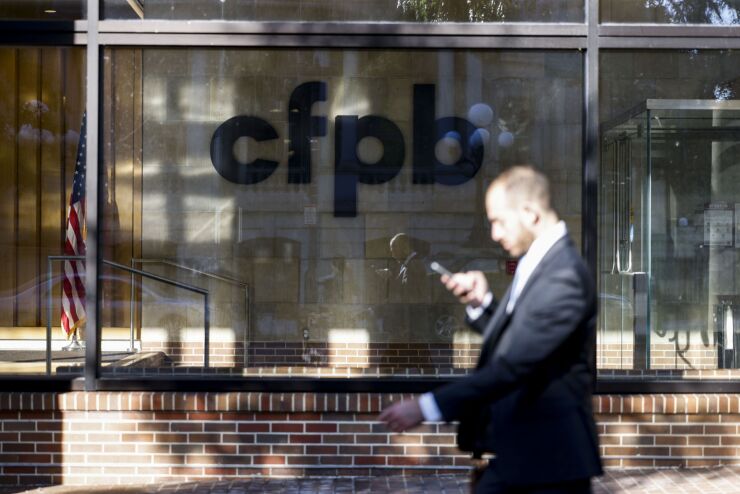
 A federal appeals court dominated in favor of the Consumer Financial Protection Bureau that introduced an enforcement motion in opposition to a Chicago mortgage lender, Townstone Financial, after its president made disparaging remarks about Blacks and Hispanics in a radio infomercial. Bloomberg News
Ting Shen/Bloomberg
A federal appeals court dominated that the Consumer Financial Protection Bureau has broad authority to discourage discrimination to fight redlining, delivering a significant victory to the bureau in a contentious case, CFPB v. Townstone Financial, in opposition to a Chicago mortgage lender.
A 3-judge panel of the U.S. Court of Appeals for the seventh Circuit dominated that the Equal Credit Opportunity Act applies not simply to credit score candidates but in addition to potential candidates.
The CFPB filed a redlining lawsuit in opposition to Townstone Financial in 2020 alleging that the corporate’s CEO Barry Sturner made disparaging remarks about Blacks on a talk-radio infomercial that discouraged minorities from making use of for residence loans. At difficulty in the case was whether or not Sturner had discouraged black potential candidates from making use of for mortgage loans with Townstone, in violation of ECOA and Regulation B — which prohibits collectors from discriminating on the premise of intercourse, race, shade, faith, nationwide origin, age or marital standing.
Congress had indicated that the legislation should be construed broadly to serve the aim of ending discrimination in credit score functions, the judges stated.
“An evaluation of the textual content of the ECOA as a complete makes clear that the textual content prohibits not solely outright discrimination in opposition to candidates for credit score, but in addition the discouragement of potential candidates for credit score,” the judges wrote in a 15-page opinion. “When the textual content of the ECOA is learn as a complete, it’s clear that Congress licensed the imposition of legal responsibility for the discouragement of potential candidates. Regulation B’s prohibition on discouraging potential candidates is due to this fact in line with the ECOA’s textual content and objective.”
The CFPB had cited as proof of discrimination feedback that Sturner made on the radio industrial in which he described a Jewel-Osco grocery retailer as “Jungle Jewel,” and claimed the South Side of Chicago between Friday and Monday was “hoodlum weekend.”
The CFPB had recognized 5 cases in which Sturner and different hosts made statements that may discourage black potential candidates from making use of for mortgage loans. In addition, the bureau alleged that from 2014 to 2017, Townstone obtained fewer mortgage functions from black candidates, fewer mortgage functions for properties in neighborhoods with a high-black inhabitants, and fewer mortgage functions for properties in neighborhoods with a majority of black residents.
Last 12 months, the United States District Court for the Northern District of Illinois dismissed the case in the favor of Townstone by specializing in ECOA’s definition of a credit score applicant. The decrease court additionally rejected the CFPB’s argument that its enforcement and rulemaking authority allowed it to prohibit discouragement of potential candidates. The CFPB appealed.
“The district court held that the ECOA doesn’t authorize the imposition of legal responsibility for the discouragement of potential candidates. We take a distinct view,” the judges wrote.
“The time period “applicant” can’t be learn in a crabbed vogue that frustrates the plain statutorily articulated objective of the statute,” the judges wrote. “Indeed, the ECOA’s scope of prohibition prohibits discrimination ‘with respect to any side of a credit score transaction.’ ”
The case was reversed and remanded again to the district court.
“Discouraging candidates is the primary software in the e-book of redlining. A discriminatory lender could really feel like utilizing a ‘Whites Only’ signal is the easiest way to accomplish their objective,” stated Adam Rust, director of monetary companies on the Consumer Federation of America. “I believe it was frequent sense to learn the legislation and are available to this conclusion.”
The CFPB didn’t instantly reply to a request for remark.
The Pacific Legal Foundation, which represented Townstone, had argued that Sturner was protected below the First Amendment.
“We’re disenchanted in the choice, which provided solely a cursory evaluation of the related statutes and ignored fully Townstone’s First Amendment arguments,” the general public curiosity legislation agency stated in an assertion. “We are contemplating our choices for additional overview.”
Townstone could enchantment the case to the complete seventh Circuit or to the Supreme Court, specialists stated.