Tag: basel

  • Fed’s Powell says new proposal for Basel III endgame is “important”

    Jerome Powell Jerome Powell, chairman of the Federal Reserve, stated the Fed board of governors favors issuing a new capital reform proposal over finalizing a modified model of the bundle put forth final 12 months.

    Tierney L. Cross/Bloomberg

    Federal Reserve Chair Jerome Powell favors issuing a new capital proposal in response to the broad issues raised in regards to the reform bundle put forth by financial institution regulators final 12 months. But it is unclear if different Washington regulators really feel the identical.

    During testimony in entrance of the Senate Banking Committee on Tuesday, Powell stated the Fed has made important progress in absorbing the varied feedback it acquired in regards to the so-called Basel III endgame proposal and is “shut” to agreeing with the Federal Deposit Insurance Corp. and the Office of the Comptroller of the Currency on a path ahead. 

    Powell declined to debate particular modifications to the proposal, however stated an extra spherical of public commentary is “important,” given the diploma of modification.

    “My view, the strongly held view of the board, is that we do must put a revised proposal out for remark for some interval, and the explanation is when there are broad and materials modifications, that has been our observe,” he stated. “We do not see a purpose to deviate from that observe, it appears to be in keeping with previous observe and with the Administrative Procedure Act, in order that’s very a lot what we predict.”

    Powell stated Fed Vice Chair for Supervision Michael Barr, the central financial institution’s high regulatory official, is engaged together with his counterparts on the FDIC and the OCC, however the three businesses have but to make any remaining choices.

    The OCC declined to touch upon Powell’s remarks and the FDIC didn’t instantly reply to a request for remark.

    FDIC board member Jonathan McKernan — a Republican and frequent dissenter to the company’s regulatory insurance policies — expressed assist for opening the amended proposal to a different spherical of public commentary.

    “Count me in settlement with the strongly held view of others that we have to repropose the Endgame proposal with broad and materials modifications,” McKernan posted on X, the social community previously often known as Twitter, on Tuesday afternoon. 

    Powell stated he want to see the amended capital proposal issued for public remark alongside the findings of the Fed’s quantitative affect evaluation of how the most important 30 or so banks within the nation could be impacted by the new capital framework. He famous that the new proposal would seemingly include a remark window of 60 days or so, considerably shorter than the 120-day interval for the preliminary proposal.

    Powell stated there is “fairly a bit of labor” to be executed earlier than a revised proposal will be issued. He added that it additionally takes a number of months for feedback to be absorbed and included into the ultimate rule. He famous that the ultimate rule seemingly wouldn’t come collectively earlier than the top of 2024. 

    “It’s onerous to be exact,” Powell stated. “You write these things up, then you definately put it out for feedback, then you definately learn the feedback, then you definately write the ultimate rule. The starting a part of subsequent 12 months is a superb guesstimate.”

    Powell declined to say whether or not he thought the modifications being thought-about would represent a “logical outgrowth” from the unique proposal. If they had been, regulators may legally transfer to finalize the rule instantly, whereas in the event that they weren’t, a new discover and remark course of could be required below the Administrative Procedure Act.

    Proponents of the capital reform have argued that the broad set of questions requested by regulators once they issued the proposal final summer time offers them ample room to switch the rule and transfer straight to finalization. 

    Supporters of the proposal took situation with Powell’s feedback. Jeremy Kress, a legislation professor on the University of Michigan and a former Fed lawyer, stated the Fed chair is successfully “exercising a unilateral veto” on a direct finalization. 

    In a publish on X, Kress additionally stated it was a breach of etiquette for one financial institution regulator to overtly focus on divergent coverage views of different businesses.

    “Setting apart Powell’s private views on Endgame, it is uncommon for a Fed official to reveal an interagency rift to Congress with out the opposite businesses there to make their case,” Kress wrote.

    Opponents of the Basel III endgame, in the meantime, will likely be scrutinizing the subsequent proposal fastidiously. Trade teams representing the big banks have already signaled their readiness to sue regulators over the capital rule if it is not modified considerably, even going as far as to retain one of many high administrative attorneys within the nation to deal with the case. 

    Following the listening to, Greg Baer, president and CEO of the Bank Policy Institute, stated Powell’s feedback had been encouraging, however he famous that the banking commerce teams usually are not prepared to face down simply but. 

    “We are heartened that the proposal has been rethought and that the general public can have an opportunity to touch upon the rethinking; nonetheless, the main points listed below are essential, so clearly we might want to see the scope and particulars,” Baer stated in a written assertion. “And after all there stays the query of how the Basel proposal suits with the Federal Reserve’s stress check, the GSIB surcharge and different regulatory necessities.”
  • Getting to certainly: Reported Basel retooling may — or may not — have legs

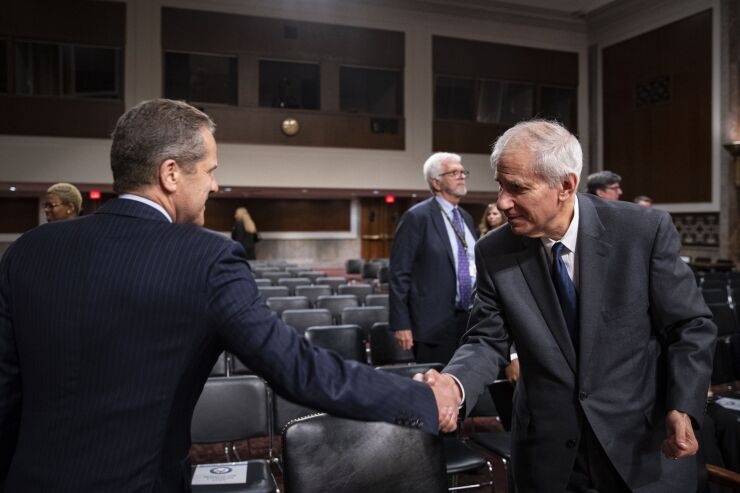
    Barr Gruenberg Michael Barr, vice chair for supervision on the Federal Reserve, remaining, shakes palms with Martin Gruenberg, chair of the Federal Deposit Insurance insurance policies Corp., adhering to a Senate Banking Committee listening to previous Might. Regulators are reportedly poised to supply a retooled Basel III endgame rule that noticeably scales again a number of the way more controversial points of earlier July’s proposed rule, however regardless of whether or not all these variations are ample to quell banks’ opposition is unclear.

    Bloomberg News

    WASHINGTON — Whilst it actually is obvious lender regulators put together to make substantive enhancements to a financial institution capital overhaul demanding institutions to put up much more unborrowed cash to lend to customers, banking business consultants differ on how this might probably be completed, and whether or not even a revised proposal will likely be sufficient to preclude lawful difficulties from the banking enterprise.

    The Basel proposal was hotly contested when it was first proposed remaining July on quite a lot of grounds, along with the leading-line money enhance for the foremost monetary establishments, the prospect weight remedy of mortgages, clear electrical energy property and compact enterprise loans. Bloomberg reported final 7 days that regulators are searching a draft set of revisions to the proposal aimed toward quelling these issues.

    Lawyer Gregory Lyons of Debevoise and Plimpton mentioned he is not actually assured of the timeline simply however, supplied regulators nonetheless present up to be hashing objects out internally.

    “I think about yow will discover distinctive proposals circling about how to amend it, however in truth, I’m not assured they know,” said Lyons. “We are fairly shut to what’s probably on and I simply do think about yow will discover a complete lot of inside — superior faith — however inside debates about how that is all going to have interaction in out.”

    Corporate legal professional Chen Xu, additionally with Debevoise, says he thinks the heads of the companies involved within the rulemaking — which is a joint effort and exhausting work involving the Federal Reserve, the Office of the Comptroller of the Forex and the Federal Deposit Insurance insurance policies Corp. — would really like to strike a compromise with their funds skeptic colleagues, a few of that are in the very same firm. 

    “Some of the corporate principals hope in the event that they make ample concessions, they’ll get it through by August so this is not going to get tied up with the election,” he claimed. “We’ve been listening to that try is attaining traction, however we have additionally learn that there are a amount of parents contained in the companies who would considerably have a reproposal, and splendid now it’s difficult to see who’s successful.”

    But whether or not these modifications will be included right into a remaining proposal or ought to be included in a brand new proposal — or some mixture of the 2 — stays unclear. Below the Administrative Method Act, variations produced to remaining guidelines want to be a “affordable outgrowth” of what was within the genuine proposed rule. Lots of in and throughout the banking sector argue that the enhancements required for the Basel III endgame proposal exceed this typical, and for that motive an absolutely new rule want to be put by its private observe and comment time period.

    Jaret Seiberg, cash protection analyst at TD Cowen says he expects regulators will on the very least partially withdraw and re-propose the rule — steadily dubbed Basel III endgame — supplied statements from a single of essentially the most influential avid gamers shaping the pending regulation: Federal Reserve chair Jerome Powell.

    “Powell has effectively designed this motivation to Congress,” commented Seiberg. “It does not signify there’s zero probability for the rule to be finalized, however a re-proposal appears to be like most likely.” 

    Regulators invited banking corporations to present particulars about how they’d suffer from the proposal in January. Seiberg claims the outcomes of the analysis — which he predicts should come this summer season — ought to supply additional readability about regardless of whether or not or how swiftly a re-proposal might happen.

    Whilst the Fed is essentially the most politically unbiased of the fiscal regulators, it’s experiencing drive from each equally the financial subject — which wants a re-proposed rule — when some Democrats and shopper advocates need the rule accomplished primarily as is. A brand new proposal would considerably enhance the timeline for finalization. Banking protection professional Ian Katz of Capital Alpha Partners states the Fed might devise a method to allow public comment on specific rule revisions with out restarting the system.

    “The Fed may maybe place out one thing that in essence looks like a reproposal however is known as a factor else and can enable most of the people to comment with out the necessity of establishing the process from scratch,” said Katz. “If the Fed have been to do this within the tumble — forward of the elections — it might finalize the Basel endgame rule subsequent calendar yr, perhaps within the 1st 50 p.c.”

    Banking corporations and their commerce crew reps have been vocal of their opposition to the Basel proposal and have availed themselves of novel methods in elevating the issue with voters and lawmakers. From launching selling campaigns on Sunday night soccer to determining procedural weaknesses they might downside in court docket, the sector has produced it obvious that it’s going to oppose the rule on as fairly a number of fronts as possible. Financial establishment commerce crew the Lender Coverage Institute, whose associates would all be impacted by the rule, has retained company litigator Eugene Scalia — son of former Supreme Court docket Justice Antonin Scalia — to recommend a probable approved impediment to the rule.

    Though the corporate trio has nevertheless to formally announce deliberate revisions to the rule, market allies inside the regulatory state have begun to current cowl for the kinds of variations monetary establishments are demanding.

    Fed Governor Michelle Bowman — who has beforehand known as for the rule to be reproposed —  Wednesday floated a amount of modifications she thinks are required to garner vast consensus among the many Fed’s deliberative system, the Board of Governors. She argues the rule does minimal to cope with the basic causes of essentially the most newest U.S. monetary establishment failures in March 2023.

    “I take into account we tackled the challenges that we confronted in the course of the earlier than monetary catastrophe by the implementation of Dodd Frank, I assume individuals have confirmed to be thriving,” she reported. “What led to SVB failing was not the similar subject that led to the real property disaster once more then, earlier than, a ten years prior to now.”

    Powell has often pressured the need for this consensus. Bowman termed for the companies’ to pare again once more what she known as redundancies within the funds framework — between the brand new business and operational probability wants within the rule and the strain cash buffer which she claims burdens banks with redundant costs. She additionally known as to recalibrate the present market threat issue of the rule to mitigate substantial will enhance in threat-weighted property, and deal with non-curiosity and price-dependent income extra pretty to encourage earnings diversification. She produced very clear as soon as once more this 7 days she believes any rule that may proceed — enable by yourself method finalization — would require broad changes and enter from fascinated get-togethers within the business and typical basic public. 

    “​​While these actions can be a acceptable commencing place, they’re not a substitute for a knowledge-driven evaluation and an intensive assessment of the evaluations submitted,” she talked about throughout a fireplace chat adhering to her remarks. “This would end result in a superior proposal that options alterations to cope with not solely these points, but in addition a number of different points raised by most of the people.”

    Lyons says two of the important thing issues banking establishments have decided with the rule are the scope of banks — primarily these individuals with in extra of $100 billion in property — roped into the rule’s remit, as very nicely because the business and operational threat parts flagged by Bowman, which he suggests is simply one of many very important issues for giant banking establishments.

    “I feel there are issues of relevance every to the extra substantial banks, specified the operational and present market threat issues,” he claimed. “And to the smaller sized monetary establishments, within the $100 billion asset class, pertaining to how a lot of this may apply to them.”

    Irrespective of what route regulators simply take, the banking market and its allies have questioned the require for money reforms within the to begin with place, supplied their see that firms are effectively-capitalized. But pretty than battle tooth-and-nail to cease any new money requirements, some assume they may probably settle for a slimmed-down version of the proposal in buy to accomplish regulatory certainty.

    “We assume monetary establishments would select to acknowledge a smart final rule than to enhance this combat for what might be yet one more 5 yrs,” Seiberg remarked. “The timing for finalizing the rule is correct after the inauguration. It is why there’s election hazard, nevertheless we take into account the majority of the final rule is probably going to have bipartisan help on the Federal Reserve.”

    Given ongoing talks on the organizations about how to proceed, the business will more than likely be eyeing its allies on the within of, who can assist kind the rule to their liking. Bowman’s opinions on Wednesday recommend the enterprise might get their method in numerous regards. 

    “As Chair Powell has defined, that he expects broad and supplies enhance to this proposal, and I’d hope {that a} vary of the factors that I have decided in a collection of speeches all around the final 12 months or because the proposal was launched can be built-in in a few of individuals changes,” she defined. “If the proposal is [put] forward, it has to be voted on by the board and the opposite regulatory organizations — so we’re going to simply have to see what takes place.”

    Lyons talked about a Supreme Courtroom conclusion Friday upending the Chevron doctrine — which usually mentioned judges ought to actually defer to company judgment on rulemakings — will increase the stress on regulators to make certain their closing rule is something banking corporations can reside with. With the repeal of Chevron, regulators now have to persuade courts of the deserves of non-public restrictions.

    “[Chevron] raises the dilemma of how considerably the courts have to defer to the businesses in rulemakings and so forth,” he talked about. “I think about it heightens the stakes — or hazards, based mostly in your place of watch — banking organizations or their commerce teams may maybe press once more in court docket docket from pointers they perceive to be problematic.”

    Kyle Campbell contributed to this posting.

  • Financial institutions remaining in limbo as regulators mull route forward for Basel

    Barr Gruenberg Federal Reserve Vice Chair for Supervision Michael Barr and Federal Deposit Coverage Corp. Chair Martin Gruenberg are high the drive for massive financial institution money reform, together with performing Comptroller of the Forex Michael Hsu.

    Anna Rose Layden/Bloomberg

    Washington’s controversial cash proposal is on preserve indefinitely as regulators work out a possible route forward for the reform provide. In the meantime, the banking sector continues to be left in limbo. 

    Improvements are coming to the so-named Basel III endgame — which might improve cumulative funds calls for for substantial monetary institutions by 16%  — however irrespective of if regulators modify the current proposal or unveil a wholly new supplying continues to be to be discovered. 

    Based on the tack taken by the Federal Reserve, the Federal Deposit Insurance protection Corp. and the Place of labor of the Comptroller of the Currency, adopting new funds guidelines may get anywhere from a pair months to completely above a 12 months. And their distinct alterations may final result in an unlimited number of outcomes. 

    For banking firms keen on altering their small enterprise merchandise and concord sheets to satisfy regulatory necessities as quickly as potential, this uncertainty suggests possessing to prepare for all choices.

    “Our institutions do not know what the trail forward is, so they’re prone to run on the idea of remaining ready for whichever outcomes may occur,” defined Kevin Fromer, president and CEO of the Money Products and companies Forum, a commerce staff for the eight largest banking firms in the nation. “Buyers count on our associates to fulfill regulatory proposals lengthy previous to they’re utilized, and so they as a outcome should be able to deal with their cash in keeping with the best info that they’ve.”

    Francisco Covas, authorities vice chairman and head of examine on the banking commerce group Lender Coverage Institute, talked about the group began advising its clients to retain earnings and purchase different preemptive methods when the proposal was issued final summer season.

    The consensus try is that the final mannequin of the rule — having stated that it’s attained — will embody decreased capital wants than in the unique put together. But, Covas acknowledged the uncertainty suggests banking firms should be conservative till they know the way and when these modifications are potential to contemplate outcome.

    “Until this will get mounted in circumstances of the timing, companies will probably be cautious on how they’re prone to deploy funds and think about benefit of prospects that crop up,” he acknowledged. “We are eager to know far more particulars and particularly wherever factors will inevitably land.”

    Fed Chair Jerome Powell promised “vast and supplies” changes throughout congressional testimony in March. He additional that he can be open to issuing a brand new proposal, if the diploma of alter warranted this form of a go.

    Previous 7 days, Powell claimed the central lender stays absolutely commited to using the worldwide benchmarks agreed upon by the Basel Committee on Banking Supervision in 2017. He additional that the proposal is the company’s main regulatory precedence, however stated the Fed’s board of governors has not settled on a program of motion.

    “We have not constructed any alternatives on coverage or on methodology in any respect, nothing — no alternatives have been created,” Powell talked about all by way of his put up-Federal Open Current market Committee push assembly. “I’ll say but once more, although, if we conclude that reproposal is good, we might not wait to insist on that.”

    The FDIC and OCC declined to touch upon the rulemaking course of this 7 days. 

    Company rulemakings are dominated by the Administrative Method Act, which calls for coverage alterations to be put as a results of a so-known as discover and remark process for the general public to weigh in on the proposal and voice worries. Businesses ought to then take in this commentary, reply to it and, the place by acceptable, use it to amend the closing mannequin of a rule. 

    Changes manufactured to remaining guidelines should be a “rational outgrowth” of what was in the genuine proposed rule. Several in and throughout the banking sector argue that the enhancements needed for the Basel III endgame proposal exceed this regular, and therefore a wholly new rule ought to actually be set by the use of its have detect and remark interval. 

    “The rule want to enhance significantly supplied the fears elevated by a broad spectrum of industries and firms, the envisioned have an effect on on the financial local weather, the complexity of the rule, as properly as the impacts it has on different sections of the cash framework and regulation,” Fromer defined. “With most of these substantial enhancements anticipated, the enterprise and different intrigued events ought to actually be outfitted to know all these enhancements and touch upon them to make completely positive there aren’t unintended repercussions. That can be a smart means forward for a rule that has elevated extremely substantive points and many system points as successfully.”

    Other people say the regulators have an enormous berth for creating enhancements beneath the cheap outgrowth doctrine. 

    Jeremy Kress, a regulation professor on the College of Michigan and a former Fed legislation agency, reported companies are offered vast deference on what’s a rational outgrowth. He additional that the way in which regulators approached the Basel III endgame — by which embody 174 particular queries and alternate options for some provisions — gave them sufficient latitude to make enhancements with out the necessity of attending to repropose.

    “As lengthy as they’re in the realm of chance-centered cash working with credit score historical past danger, operational hazard and sector hazard, the companies have opened these frameworks for most of these broad remark and have obtained this sort of vast comment and on all components of people difficulties, that they’ve a really substantial amount of leeway in going straight to a remaining rule,” Kress reported.

    The Fed, FDIC and OCC obtained much more than 400 letters concerning the Basel III endgame for the period of an prolonged remark time interval of virtually six months. Even in the course of typical rulemakings, the consider method usually takes fairly a number of months. But not solely has the Basel III endgame proposal acquired additional opinions than traditional, the commentary can also be decidedly simply one-sided, with 97% of responses turning into antagonistic, in keeping with evaluation by the regulation group Latham & Watkins.

    Shayna Olesiuk, director of banking protection for the customer advocacy group Superior Marketplaces, talked about the intensive opposition has contributed to a story in and throughout the banking sector that reproposal is required. In actuality, she acknowledged, a whole lot of of the problems might be addressed by creating minor changes to the proposal.

    “In quite a few methods, the quantity of opposition to the proposal does expertise like new territory,” Olesiuk claimed. “But regardless of this, we should always actually not and are unable to remove emphasis on the a number of essential advantages of the rulemaking for the American women and men, like economical safety and elevated lending by way of the ups and downs of the financial cycle.”

    Improvement of the Basel III endgame — be it finalization or reproposal — appears to hinge on the Fed governors arriving at what Powell has described as a “consensus” perspective on easy methods to go forward. This in all probability suggests the up coming version of the proposal should safe assist from Powell and Fed Vice Chair Philip Jefferson, each of whom voted in favor of the unique model final July however with main reservations. Two different board associates, Govs. Michelle Bowman and Christopher Waller, voted versus the proposal and proceed to be against it.

    At the time of the proposal, Powell noticed many areas that he want to see suggestions on, just like the proposal’s results on money markets and operational danger administration. He additionally flagged the truth that the proposal exceeds the conventional set by the Basel Committee and equal reforms at the moment being considered by regulatory businesses throughout the setting — some extent he reiterated final 7 days, noting that the rule should be “reliable to Basel and likewise equal to what the opposite substantial comparable jurisdictions are finishing up.”

    Jefferson has shared variety of opinions on the proposal because of the reality it was launched ultimate summer season season. But, on the time, he expressed drawback concerning the framework’s impression on the banking sector and the broader monetary state. 

    Olesiuk, a earlier deputy director for deposit protection and hazard analysis on the FDIC, reported there are quite a few methods for regulators to tweak the proposal with out having touching its most important elements.

    “Generating adjustments on the credit score facet can be an inexpensive trade-off to take care of issues like operational and market place menace, that are significantly additional important in magnitude and materially bolster the funds framework,” she defined.

    Some say the operational changes — exactly the shift away from banking institutions staying ready to make use of inner designs to standardized varieties for calculating capital wants — are essentially the most onerous in the proposal and should be altered. 

    Other analysts have identified that changes may very well be designed to cut back the whole funds load of the reform. These might encompass amending the surcharge proposal for worldwide systemically important banking firms, or GSIBs, that was put out together with the Basel III reform or dropping the fear funds buffer prerequisite from the lately expanded danger-dependent technique.

    Regardless of what trade-offs are made internally inside the businesses, the final model of the rule — irrespective of if it comes in a while this calendar yr or additional down the road — will probably be vastly scrutinized by the banking enterprise, which has expressed a bigger willingness to sue its regulators in new years.

    “I hope and expect that the banking businesses need to get this carried out and need to get it executed in a means which goes to defend it from market points,” Kress reported.